Why the Netherlands Leads the Global Potato Industry
Netherlands potato industry: why the Dutch lead global seed potato exports, processing and farming innovation, with 2024-2026 trade data, key figures and industry analysis
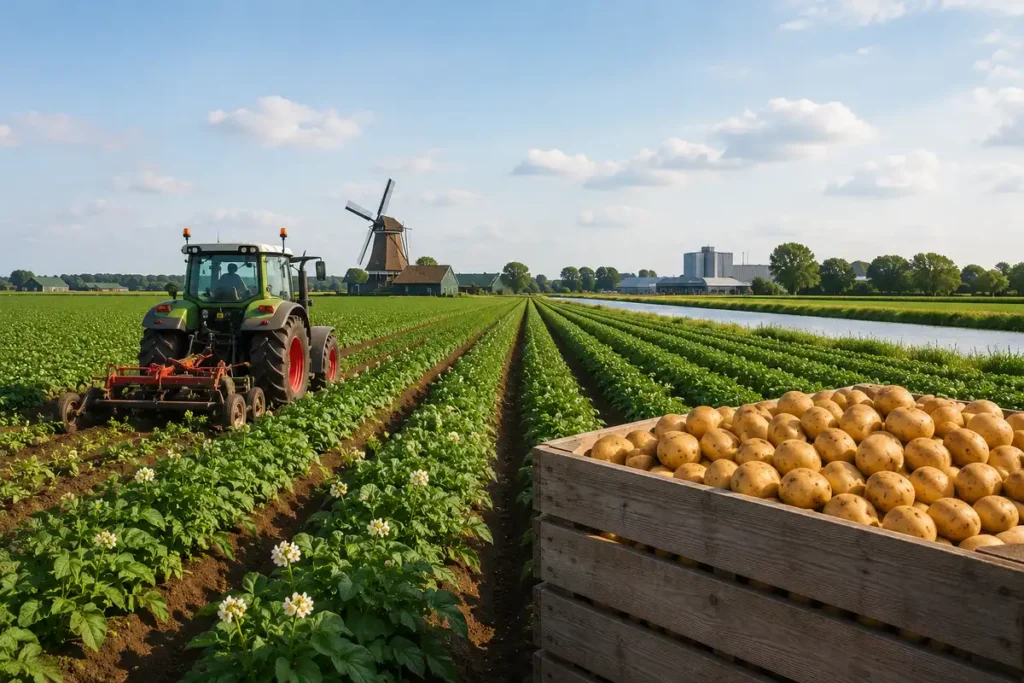
The Netherlands is the world’s top potato exporter by value. In 2024, Dutch potato exports reached USD 1.40 billion, up USD 185 million from the year before. For a country roughly the size of West Virginia, that’s a remarkable feat. And it didn’t happen by growing more land. It happened by growing smarter.
The Dutch produce roughly 7 million tonnes of potatoes each year from about 25% of their arable land. Average yields run above 45 tonnes per hectare, well above the global average. More than half of what they grow gets exported, either as fresh potatoes, seed potatoes or processed products like frozen fries.
Their processed potato output reaches 150 countries. In the seed potato trade, they have no real rival. This article covers the full picture, how the Netherlands built this dominance, what drives it today and why countries from Egypt to Indonesia keep buying Dutch.
The Seed Potato Business: Where Dutch Dominance Is Absolute
The Netherlands ships around 700,000 tonnes of certified seed potatoes every year. No other country comes close. These are the planting seeds that farmers in dozens of countries rely on to grow their own crops and Dutch seed varieties are chosen for disease resistance, high yield and consistent quality.
Seed potato exports generated USD 758.5 million in 2024 alone. That’s more than half of the Netherlands’ total potato export revenue, coming from a segment most consumers have never heard of. Egypt, Algeria, Morocco and several West African nations import Dutch seed potatoes to support their domestic production.
The Netherlands isn’t just feeding people. It’s supplying the inputs that help other countries feed themselves.
Why does seed quality matter so much? A farmer planting inferior seed risks lower yields, more disease and harder-to-sell output. Dutch seed potatoes carry internationally recognized certification, which is why buyers keep coming back even when cheaper alternatives exist.
The breeding programs behind these varieties are decades in the making. Dutch seed companies like HZPC, Agrico and Averis Seeds operate global R&D programs. New varieties are tested for resistance to late blight, nematodes and virus strains before they reach the market.
This long-cycle investment is what competitors struggle to replicate quickly.
Also read: Potato Consumption Per Capita by Country
You might also like
-
 Complete Frozen French Fries Production Line Guide (2026)
 -
 How Climate Change Is Affecting U.S. Potato Production
 -
 Best Climate and Soil Conditions for Potato Farming
 -
 Potato Export from India: A Complete Guide (2026)
 -
 Top Potato Exporting Countries Ranked by Value
 -
 U.S. Potato Acreage Falls 3% in 2026: What It Means
Precision Farming: How Dutch Farmers Get So Much From So Little Land
Dutch potato yields are among the highest in the world. Farmers routinely achieve 45 tonnes or more per hectare. The global average sits well below that. The difference isn’t luck or soil alone. It’s technology, data and a farming culture that treats efficiency as a professional standard.
Jacob van den Borne, a third-generation Dutch potato farmer, became internationally known for using sensor arrays, drones and data analytics across his fields.
He’s an example, not an exception. Dutch farming broadly runs on precision inputs: drip irrigation, soil sensors, late blight forecasting systems, optical disease-detection readers and controlled traffic farming that reduces soil compaction.
Wageningen University & Research (WUR), based in Lelystad, sits at the center of this. It’s consistently ranked among the world’s top agricultural research institutions. WUR’s Farm of the Future experiment grows eight crops simultaneously, tests sustainable rotation models and develops agronomic practices that Dutch farmers can adopt in real fields.
The university works directly with industry and with government, which shortens the path from research to practice.
The Netherlands also exports not just potatoes, but agricultural technology itself. Greenhouse design, precision agtech, sensor systems and automated machinery developed in the Dutch ecosystem are adopted by farmers worldwide. The country exports farming knowledge as a product in its own right.
Netherlands Potato Industry: Key Figures
| Indicator | Value / Volume | Source |
| Total potato exports (2024) | USD 1.40 billion | UN Comtrade |
| Seed potato exports (2024) | USD 758.5 million | UN Comtrade / potatoes.news |
| Certified seed potato exports | ~700,000 tonnes/year | FAO / PotatoPro |
| Annual processed potato volume | ~4 million tonnes | VAVI 2022 |
| Export destinations (processed) | 150 countries | VAVI 2022 |
| Dutch potato yield | Up to 45+ tonnes/hectare | FAO / PotatoPro |
| Arable land under potatoes | ~25% of arable area | PotatoPro |
| Dutch agricultural exports total | ~EUR 100 billion/year | Farmonaut / Dutch govt |
Sources: UN Comtrade, VAVI, FAO, Farmonaut—2022-2025 data
Processing Power: Fries, Starch and 150 Export Markets
Fresh potatoes are only part of the Dutch story. The Netherlands processes roughly 4 million tonnes of potato each year and exports the output to around 150 countries. That makes it one of the most globally connected potato processors on Earth.
The processing sector handles frozen fries, potato chips, mashed potato products, potato starch and more. About 70% of processed product stays within the EU, with the remaining 30% going to markets worldwide. Belgium, Germany, France and the UK are the biggest European buyers.
Beyond Europe, West Africa and Central America are growing export destinations.
The country’s position in Europe’s potato belt gives it a logistics advantage. The port of Rotterdam, the largest in Europe, sits at the heart of Dutch agricultural trade. Cold-chain infrastructure is well-developed and the road and rail networks connecting the Netherlands to its neighbors reduce friction at every step.
It’s worth noting that the Netherlands also imports additional ware potatoes from Germany and Belgium to keep its processing plants running at full capacity. This makes the Dutch less a pure producer and more a processing and trade hub, which is a smarter long-term position than volume farming alone.
Also read: Top Potato Exporting Countries Ranked by Value
Sustainability and Climate Pressure: The Next Challenge
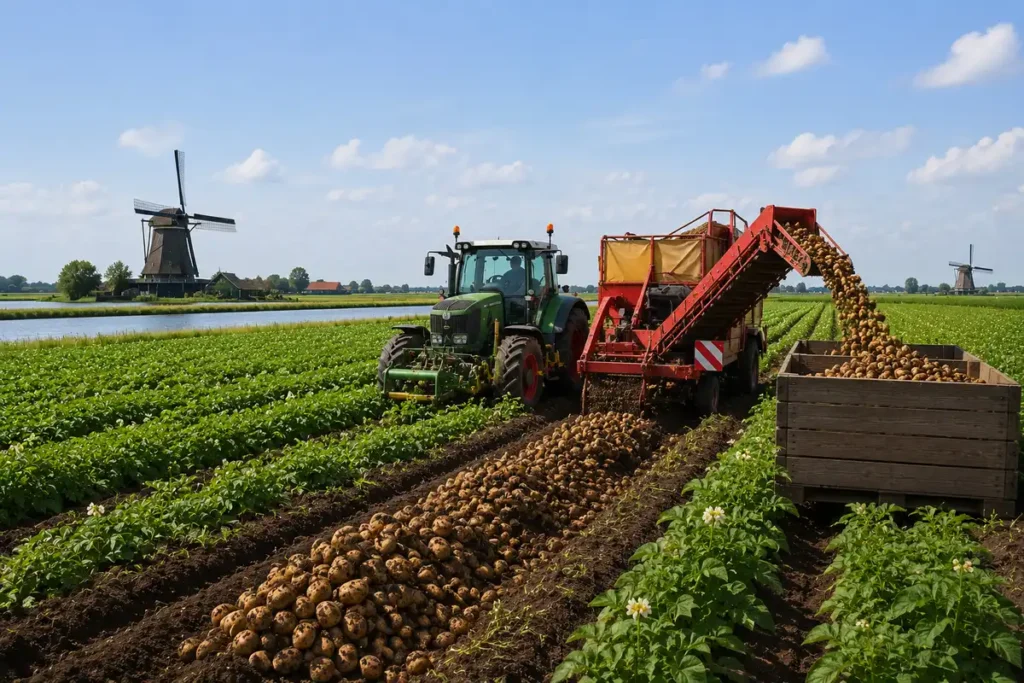
Dutch agriculture uses 90% less water and 97% fewer pesticides per unit of output compared to conventional systems in many countries, largely because of greenhouse technology and precision inputs. But the potato sector faces real pressure as the climate shifts.
Soil health is a growing concern. Intensive potato rotations over decades have led to what some researchers call ‘tired soils’, where structure, biology and natural fertility decline. Wageningen researchers and organic farmers are actively working on solutions: wider crop rotations, cover crops, green manure, reduced tillage and precision fertilizer application.
New climate-resilient potato varieties are also in development. WUR’s breeding programs focus on traits like improved yield stability under heat stress, better root systems and reduced water dependence.
These varieties matter not just for the Netherlands but for export markets where climate volatility is already hitting harvests hard.
PotatoEurope 2025, held at WUR’s field site in Lelystad, brought together 350 national and international exhibitors and focused heavily on sustainability, climate adaptation and agritech integration. That the world’s most important potato technology event chose the Netherlands as its host site says something about where global leadership sits.
EU Trade Dynamics and Shifting Export Patterns
Dutch potato exports operate within a complex European trade web. Belgium is historically the Netherlands’ largest single export market, but that relationship shifted in 2025. Exports to Belgium fell around 21% in the first nine months of the year as Belgian farmers produced a larger-than-usual domestic crop.
Germany moved the other way. Dutch potato imports into Germany surged to more than triple the previous year’s volume, suggesting regional shortages or quality gaps that Dutch suppliers were well-placed to fill.
Beyond Europe, the trend is clear. Africa is growing fast as a destination. Côte d’Ivoire leads African imports of Dutch potatoes and new markets in Central and South America are opening. This geographic diversification is a deliberate strategy. As EU partners become more self-sufficient in strong harvest years, Dutch exporters are building relationships in regions where demand is structurally growing.
The top five EU potato exporting countries in 2024 were Belgium, France, Germany, the Netherlands and Poland, together accounting for 98.2% of total EU export value. The Netherlands sits firmly in that group. And in seed potatoes specifically, it holds the top spot globally, which no seasonal harvest fluctuation can easily dislodge.
Also read: Top 10 Potato Producing Countries in the World
The Real Reason the Dutch Win: A System, Not a Secret
The Netherlands’ success in potatoes isn’t one big advantage. It’s a system of connected strengths that reinforce each other. Pull any one piece out and the others still hold. Build all of them together, as the Dutch have over decades and the result is a hard-to-beat position.
The key pillars of Dutch potato leadership:
- World-class seed potato breeding backed by decades of R&D
- High yields from precision farming, data tools and soil science
- A processing sector that exports to 150 countries
- Wageningen University as a global research hub connected to industry
- Rotterdam’s port and cold-chain infrastructure for fast, reliable logistics
- Government and private sector cooperation on standards and certification
- A culture of agricultural professionalism passed across generations
Other countries produce more potatoes by volume. China produces roughly 95 million tonnes a year. India grows tens of millions. But neither ships certified seed potatoes to 70-plus countries, nor commands the pricing premium that Dutch varieties get. Volume is not the same as value and the Netherlands long ago chose the value lane.
What This Means for the Global Potato Industry
The Netherlands’ position at the top of the global potato trade is well-earned and not easily challenged. Its seed potato dominance, processing capacity and research infrastructure give it structural advantages that take decades to build.
Competing countries can grow more volume. They can’t quickly replicate the certification trust, the variety pipeline or the WUR research ecosystem.
The near-term challenges are real. Shifting EU trade patterns mean Dutch exporters have to work harder for market share in some years. Climate pressure on soils and yields is a legitimate threat. And regulators are pushing harder on sustainability standards across the board.
But the Dutch are actively addressing those challenges at the same place where they built their advantage: through research, investment and the kind of long-term thinking that made the Netherlands a potato powerhouse in the first place.
For anyone tracking the global potato industry, this small country remains the most important player to watch.
Also read: Idaho Potatoes vs Russet Potatoes – What’s the Real Difference?
Frequently Asked Questions (FAQs)
-
Why is the Netherlands the world’s top potato exporter?
Dutch potato exports reached USD 1.40 billion in 2024, driven by world-class seed potato varieties, advanced precision farming, strong processing capacity and superior logistics through the port of Rotterdam. No other country matches their combination of seed quality, yield technology and global trade reach.
-
What makes Dutch seed potatoes so valuable?
Dutch seed potatoes carry internationally certified disease-resistant, high-yield varieties developed through decades of breeding programs by companies like HZPC and Agrico. Buyers in over 70 countries trust Dutch seed for consistent quality, which commands a price premium over uncertified alternatives.
-
How much does the Netherlands export in seed potatoes each year?
The Netherlands exports around 700,000 tonnes of certified seed potatoes annually, generating USD 758.5 million in 2024 according to UN Comtrade data. Seed potatoes account for more than half of the Netherlands’ total potato export revenue.
-
What role does Wageningen University play in the Dutch potato industry?
Wageningen University & Research (WUR) is one of the world’s top agricultural research institutions. It develops new potato varieties, agronomic practices and sustainable farming systems. WUR works directly with industry and government, which accelerates the adoption of new techniques across Dutch farms.
-
Is the Netherlands’ potato export dominance at risk?
Short-term trade shifts and climate pressure on soils are real challenges. Exports to Belgium fell around 21% in early 2025 due to a strong Belgian domestic harvest. But seed potato dominance and processing infrastructure give the Netherlands structural advantages that competitors cannot replicate quickly.
Image credits: Potato Insights
Data source:
- The Potato Sector in the Netherlands: Players, Current Situation and Future — Wageningen University & Research (WUR)
- EUPPA Reports 7.5 Million Tons of EU Potato Processing in 2025 — Fresh Plaza
- How the Netherlands Feeds the World — National Geographic
- DLG Announces PotatoEurope Netherlands 2025 — Potato News Today
Recent Articles
"Get the latest potato industry updates in Google Search. Add Potato Insights as a preferred source for potato markets, processing, trade and industry news."