European Heatwave Raises Concerns for Potato Farmers
The 2026 European heatwave is pushing temperatures above 40°C during potato tuber bulking. Yield forecasts are down 5-7% in key markets. Here is what is at stake.
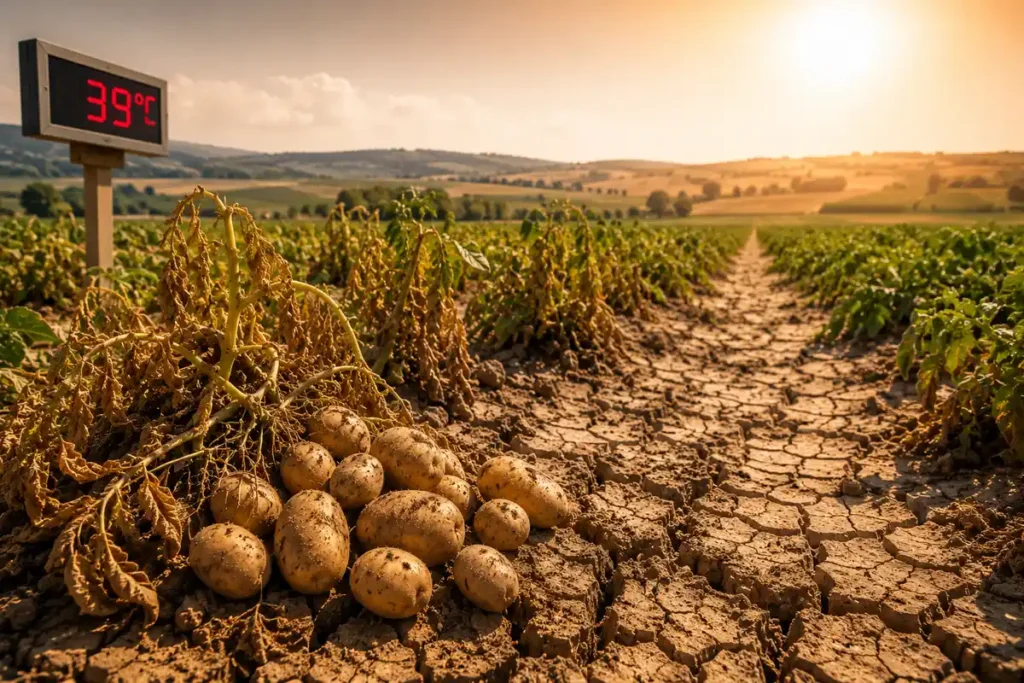
Europe’s potato sector is under serious pressure. A late-June 2026 heatwave pushed temperatures above 40 degrees Celsius across large parts of Southern, Western and Central Europe, arriving at the worst possible moment for potato crops moving through tuber initiation and bulking. France recorded 44.3 degrees Celsius on June 23rd, its hottest June day since measurements began in 1947. Germany, Denmark, Switzerland and the Czech Republic all broke national records. And unlike a sharp, short spike, this heat has been compounded by below-average rainfall stretching across weeks.
For potato farmers, the concern is specific and technical. Potatoes stop forming tubers properly above 30 degrees Celsius. A FAO and WMO joint report in 2026 confirmed that 25 degrees Celsius is the threshold above which crop yields begin to decline, with price effects persisting for up to a year afterward. When soils are dry and temperatures are running 10 to 15 degrees above that threshold for days at a time, growers face yield losses, quality defects and rising irrigation costs all at once.
Current JRC MARS forecasts already show yield expectations down 6% in the Netherlands, 5% in Belgium and 7% in Poland compared to 2025. This article covers what is happening to European potato crops right now, which regions are most exposed, what the quality and supply risks look like and what growers are doing to manage through it.
What the 2026 Heatwave Actually Looks Like
Europe in 2026 has been hit by two separate heatwave events in quick succession. The first began on May 24th, bringing temperatures higher than any previously recorded for that time of year across Western Europe. The second, more severe event started on June 17th, just days before the summer solstice and has been the more damaging of the two for agriculture.
A persistent high-pressure system described by the World Meteorological Organization and the Copernicus Climate Change Service as an Omega Block has trapped hot air over the continent while suppressing rainfall. That combination is particularly dangerous for potato crops because it drives up soil evapotranspiration at exactly the time when tubers need consistent moisture to develop correctly.
Also read: How Climate Change Is Affecting U.S. Potato Production
The geographic spread is wide. Austria, Belgium, the Czech Republic, Denmark, France, Germany, Hungary, Italy, the Netherlands, Poland, Romania, Spain and the United Kingdom have all faced severe heat warnings or broken temperature records in 2026. The European Commission’s Joint Research Centre has identified expanding areas of agricultural water stress in France, Germany, Hungary, Slovakia, Romania and Eastern Europe, where crops are now critically dependent on irrigation.
Italy shows what serious water stress looks like in practice. Exceptionally low water levels in the Po River allowed seawater to move inland, threatening irrigation supplies across one of Italy’s most important agricultural regions. The problem isn’t just heat. It’s heat combined with dwindling freshwater. Both have to be manageable at the same time for a potato crop to come through without major losses.
Why Timing Is Everything for Potato Crops
Not all heat events damage potatoes equally. What determines the severity is when the heat arrives relative to the crop’s growth stage. In late June and early July across Northwest Europe, most potato crops are in tuber initiation or early tuber bulking. These are the most temperature-sensitive phases of the plant’s development.
Tuber initiation is the window when the plant decides how many tubers it will set. High soil temperatures during this phase reduce tuber numbers directly. Bulking is when those tubers put on weight, accumulate starch and build the dry matter content that matters for processing.
You might also like
-
 Bangladesh Govt to Send Tk260cr Help to Potato Farmers
 -
 Potatoes New Zealand Backs Postponed Tour of Southland
 -
 Dhanuka Agritech Warns Potato Farmers About Early and Late Blight
 -
 New Potato Storage Site Opens in West Kazakhstan
 -
 Scientists in Punjab, Pakistan, Developed Smog-Tolerant Potatoes
 -
 Odisha Dy CM Gives Seed Potatoes to Athagarh Farmers
Heat during bulking produces smaller tubers, thinner skins and quality defects including hollow heart, secondary growth and growth cracks that make a significant share of the crop unusable for chip and frozen-fry processors.
The heat doesn’t just reduce how many potatoes grow. It changes what kind.
ARVALIS, the French crop research institute, published a technical analysis in early June explaining in detail why potatoes are particularly vulnerable during these stages. Warm nights are a specific concern the research highlighted. Plants need cooler nighttime temperatures to build sugars and starches efficiently.
When nights stay above 20 degrees Celsius, the crop cannot recover from daytime stress and cumulative damage builds faster than growers can offset it with irrigation.
What does this mean for the processing sector? Processors running contracts for frozen fries or potato chips need high dry matter and consistent size. Potatoes that come in undersized, cracked, or with hollow heart get rejected at intake, reducing the effective supply even when the physical yield isn’t dramatically lower. Quality damage can be as commercially significant as an outright yield loss when processors are buying to specification.
Also read: Why the Netherlands Leads the Global Potato Industry
2026 European Heatwave and Potato Crop: Key Data
| Indicator | Figure |
| Peak temp recorded (France, Jun 2026) | 44.3°C — hottest June day since 1947 |
| Countries breaking records (2026) | Germany, Denmark, Czechia, Switzerland +more |
| Netherlands yield forecast 2026 | 43.3 t/ha — down 6% vs 2025 |
| Germany yield forecast 2026 | 45.3 t/ha—down 1% vs 2025 |
| Belgium yield forecast 2026 | 42.8 t/ha—down 5% vs 2025 |
| Poland yield forecast 2026 | 30.5 t/ha—down 7% vs 2025 |
| Spain early yield risk estimate | Potential decline 10-15% vs optimal |
| Heatwave trigger (Omega Block) | Persistent high-pressure trapping hot air |
| FAO/WMO critical temp threshold | 25°C — above this, yields start to decline |
| EU agri-food surplus (Jan-Apr 2026) | EUR 15.6 billion (+EUR 233M vs 2025) |
Sources: JRC MARS Bulletin, Météo-France, Nieuwe Oogst, European Commission, WMO, Copernicus C3S, Reuters, Wikipedia
Spain: The Clearest Early Warning Sign
Spain is showing the most visible early impact. Heat stress has slowed potato growth across key growing regions since late May, with the crop experiencing what agricultural reports describe as sustained negative development conditions. Farmers are reporting increases in irrigation demand that their systems are struggling to meet during the hottest weeks.
Current estimates point to a potential yield decline of 10% to 15% compared to optimal conditions in affected areas and those figures could worsen if heat and drought persist through July. Spain is one of Europe’s leading potato producers and a key supplier to other EU member states during the early-season window. A shortfall there tightens supply across the continent at a time when northern European crops are not yet ready for harvest.
The Spanish situation is also compounded by reduced planted areas this year. Fewer planted hectares going into the season means the buffer against weather-related losses is smaller than usual. Spain is where the 2026 risk story is clearest right now, but agronomists monitoring Belgium, the Netherlands and France are watching closely to see whether conditions there follow the same trajectory.
Also read: Top Potato Exporting Countries Ranked by Value
Northwest Europe: The Stakes Are Higher Here
Spain matters, but the larger commercial stakes sit in Northwest Europe. Belgium, the Netherlands, northern France and western Germany form the core of Europe’s potato processing industry. Combined, they supply frozen fries and processed potato products to markets across Europe, the Middle East, Asia and beyond. The Netherlands alone exported over USD 1.4 billion worth of potatoes in 2024. Belgium is one of the world’s largest frozen fry exporters.
Current JRC MARS forecasts for these regions are already below last year before the full effect of the late-June heatwave is factored in. The Netherlands is tracking at 43.3 tonnes per hectare, down 6% from 2025. Belgium is at 42.8 tonnes per hectare, down 5%. These numbers were set before the most severe heat of late June arrived, which means they could move further in the coming forecast updates.
PotatoPro and Potato News Today both noted that analysts consider it too early to determine the full supply impact. The next two to three weeks are critical. If the Northwest European crop enters July with adequate rainfall and temperatures easing back into normal ranges, the JRC yield forecasts may stabilize or recover partially. If extreme conditions persist through the main bulking period, the processing sector could face materially tighter supply for the 2026-27 season.
Dutch potato publication Nieuwe Oogst, reporting on the JRC data, described the current situation as one of the more uncertain growing seasons in recent memory given the sequence of a dry spring, a May heatwave and now the severe late-June event hitting crops during the most sensitive growth window.
Quality Risk: The Problem Processors Fear Most
Yield volume is one concern. Quality is another and in some ways it’s harder to manage. A lower-than-expected total harvest is at least predictable. Quality defects that show up at intake inspection, after contracts have been signed and processing lines are running, create disruption that volume adjustments cannot easily fix.
Heat-stressed potato crops in 2026 risk producing elevated rates of hollow heart, secondary growth, growth cracks and irregular tuber shapes. Hollow heart forms when rapid temperature changes during bulking cause internal tissue to die. Secondary growth happens when stressed plants restart growth in bursts after heat breaks, producing knobby, misshapen tubers. Growth cracks open when moisture arrives suddenly after a dry period, splitting skins on tubers that expanded too fast.
Also read: Potato Storage Diseases and Simple Prevention
Heat-related quality defects that affect processing suitability:
- Hollow heart – internal cavity, causes rejection at processor intake
- Secondary growth – irregular shape, reduces chip and fry yield per tonne
- Growth cracks – open skin, accelerates bruising and storage losses
- Lower dry matter – reduces fry and chip quality, increases oil absorption
- Smaller average tuber size – lowers the proportion of usable processing-grade product
- Common scab – increases under hot, dry soil conditions, affects marketable appearance
Potato News Today’s analysis from late June 2026 highlighted dry matter content as the single most commercially significant quality risk. Processors running frozen fry lines need potato dry matter above a certain threshold to hit target product weight and texture. Potatoes coming in below that spec get discounted or rejected, which shifts cost back onto growers and reduces the effective supply available to processors even when physical tonnes are adequate.
Irrigation: A Partial Answer With Its Own Limits
The immediate response for most commercial potato growers during a heatwave is to irrigate. Keeping soil moisture stable during tuber bulking reduces the severity of hollow heart, secondary growth and size loss. It also helps the crop maintain canopy cover, which shades the soil and keeps root-zone temperatures lower.
But irrigation is not a complete solution in 2026, for two reasons. First, water availability itself is under stress. River levels are at record lows across parts of Southern and Central Europe. The Po River situation in Italy is the most dramatic example, but similar water table pressures exist in Spain, Hungary and Romania. Growers who depend on surface water abstraction for irrigation are finding less to draw from at exactly the moment demand is highest.
Second, the energy cost of pumping irrigation water during a heatwave has climbed sharply. Italy’s heatwave already triggered blackouts in Turin in May 2026. Running irrigation pumps at maximum capacity during a power-stressed grid is expensive, unreliable and in some regions subject to regulatory restrictions designed to prevent grid overloads.
Precision irrigation tools, soil moisture sensors and data-driven scheduling help growers use available water more efficiently. But they cannot create water that isn’t there. In regions where groundwater and river levels are already depleted, the 2026 heatwave is exposing a structural supply limit that weather alone cannot explain.
Climate Is Now a Market Force, Not Just a Farming Problem
Potato News Today published an analysis on June 29, 2026 making exactly this point: climate is no longer just an agronomic challenge for the potato industry. It is a market event. When heat and drought reduce tuber set during bulking in Northwest Europe, the consequences run through processor supply contracts, frozen food retail availability, restaurant fry supply and eventually consumer prices.
The 2026 growing season is part of a trend. The European Commission’s JRC MARS Bulletin for June noted that a dry spring and a May heatwave had already reduced yield prospects for crops across Western, Central and Eastern Europe before the late-June event arrived. The heatwaves of 2018, 2019, 2022 and now 2026 are arriving at an increasing frequency. Research published in IOP Science found that under a scenario of global warming of plus 4 degrees Celsius, over 30% of European harvested area would experience severe heat stress during critical growth windows.
The FAO and WMO’s 2026 joint report put the price effect clearly: when temperatures exceed the 25 degree threshold during critical growth periods, crop yield effects persist for up to a year in downstream food prices. Europe’s potato processing industry operates on tight seasonal supply chains. A meaningful quality or volume shortfall in the 2026 harvest will show up in frozen food pricing through the first half of 2027.
Plant breeders are working on heat and drought-tolerant potato varieties and growers are investing in precision irrigation and soil moisture management. But variety development takes years. The crops in the ground in Belgium, the Netherlands, France and Germany right now are the same varieties they were planted with in April. Whatever resilience those plants have, they have already.
Also read: Best Climate and Soil Conditions for Potato Farming
What Comes Next for the 2026 European Potato Season
The 2026 European potato season is not lost. France is actually forecast slightly higher than last year at 42.5 tonnes per hectare per the JRC MARS data, showing that regional variation remains significant. If rainfall returns to Northwest Europe in July and temperatures ease during the remainder of the bulking period, the final harvest could come in closer to normal than current forecasts suggest.
But the window is narrow. Potato News Today’s analysts called the next two to three weeks the decisive period. If the Omega Block breaks and normal Atlantic weather patterns return, growers across Belgium, the Netherlands and northern France may avoid the worst of the damage. If extreme conditions hold through mid-July, the industry is facing lower yields, elevated quality defects, tighter supply for processors and a supply chain that will feel the impact well into 2027.
The broader lesson from 2026 is the one that growers, breeders and supply chain planners are increasingly taking seriously: a European summer heatwave is no longer an unusual event that disrupts the potato industry once a decade. It is a recurring challenge that the industry has to plan for every single year. The farms are adapting, but not as fast as the climate is changing.
Frequently Asked Questions (FAQs)
-
How is the 2026 European heatwave affecting potato crops?
The late-June 2026 heatwave pushed temperatures above 40 degrees Celsius across large parts of Europe during tuber initiation and bulking, the most temperature-sensitive stages of potato development. Current JRC MARS forecasts show yield expectations down 6% in the Netherlands, 5% in Belgium and 7% in Poland vs 2025. Spain is showing early signs of a 10-15% potential yield decline in affected areas.
-
Why are potato crops particularly vulnerable to heat?
Potatoes stop forming tubers properly above 30 degrees Celsius and the FAO-WMO have identified 25 degrees as the threshold where yields begin to decline. Heat during tuber initiation reduces the number of tubers a plant sets. Heat during bulking produces smaller tubers, lower dry matter content and quality defects like hollow heart and secondary growth that make a significant portion of the crop unsuitable for processing.
-
Which European countries are most at risk from the 2026 heatwave?
Spain is showing the clearest early damage, with potential yield declines of 10-15% in heat-affected regions. The Netherlands, Belgium, France and Germany are the highest-stakes markets because they form the core of Europe’s potato processing industry. Poland, Hungary, Romania and Slovakia are also flagged by the EU’s Joint Research Centre as facing agricultural water stress.
Image credit: Potato Insights
Data source:
- Europe’s Heatwave Puts Potato Crops Under Pressure – PotatoPro
- Europe’s Heatwave Puts Potato Crops Under Pressure as Spain Reports Early Yield Concerns – Potato News Today
- 2026 European Heatwaves – Wikipedia
- Effects of Climate Change on Agriculture – Wikipedia (citing FAO/WMO 2026 report)
- The Vulnerability of European Agricultural Areas to Anthesis Heat Stress – IOP Science
- JRC MARS Bulletin, June 2026 – European Commission Joint Research Centre
Recent Articles


"Get the latest potato industry updates in Google Search. Add Potato Insights as a preferred source for potato markets, processing, trade and industry news."