USA vs Canada Frozen French Fry Industry
Compare the USA and Canada frozen French fry industries, including potato production, processing, exports, major regions, companies and US-Canada trade.
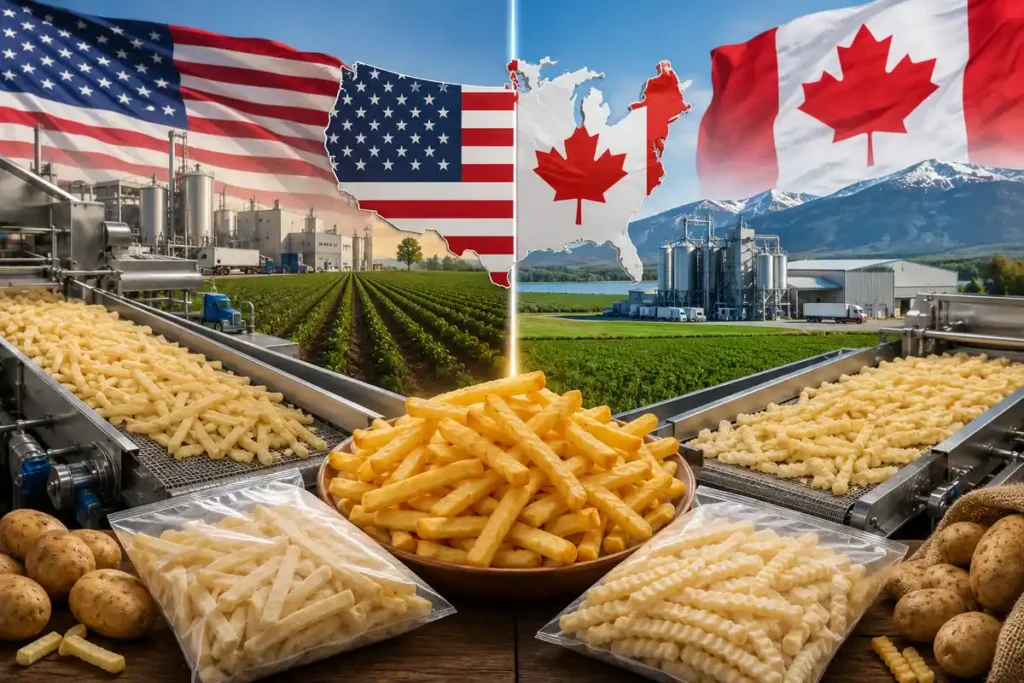
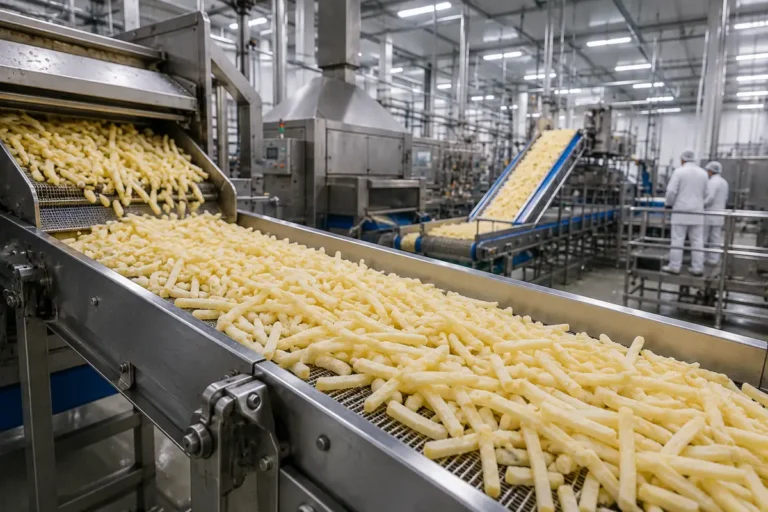
The USA and Canada are both major players in the frozen French fry business, but their industry structures are different. The USA has a much larger potato production and processing base, while Canada has a highly export-focused processing sector with the USA as its main customer.
USDA data shows that US processors used 163 million cwt of raw potatoes for frozen French fries and other frozen products in 2024. Canada, meanwhile, exported $2.7 billion worth of French fries in the 2023/24 marketing year, with the United States taking the largest share.
For foodservice buyers, processors, distributors and investors, this creates an unusual North American market. The two countries compete, but they also depend on each other.
USA vs Canada frozen French fry industry at a glance
| Factor | USA | Canada |
|---|---|---|
| Potato production scale | Much larger | Smaller |
| Frozen processing | Very large domestic industry | Large relative to national potato production |
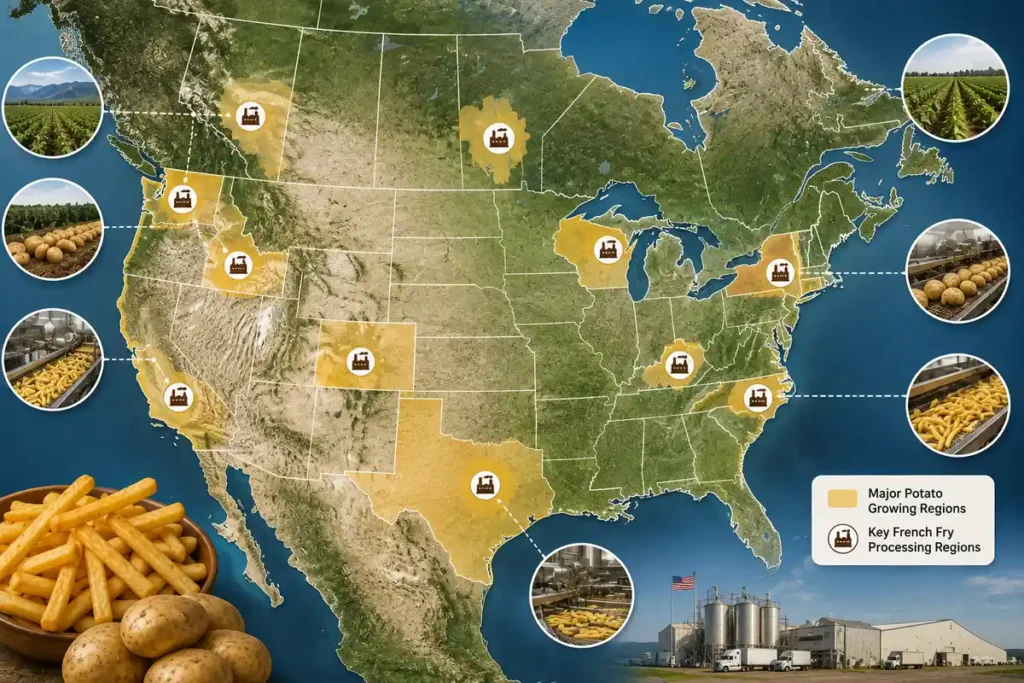
| Main processing regions | Idaho, Washington, Oregon and other major potato states | Alberta, Manitoba, New Brunswick and Prince Edward Island |
| Export role | Major global exporter | Major global exporter |
| Relationship with the other country | Imports large volumes from Canada | USA is the dominant export market |
| Main business strength | Large domestic market and processing capacity | Export-oriented processing and proximity to the US |
| Key companies | Lamb Weston, J.R. Simplot and others | McCain Foods, Cavendish Farms and others |
Also read: Best Frozen French Fries Manufacturers in the USA
How large is the US frozen French fry industry?
The USA has a large potato farming and processing system that supports both domestic consumption and exports.
USDA reported total US potato production of 421 million cwt in 2024. Growers in the 13 estimating states sold 269 million cwt of raw potatoes to processors. Frozen French fries and other frozen products accounted for 163 million cwt of potatoes used in processing.
That scale matters because frozen French fries require a steady supply of suitable processing potatoes. Large processors also need storage, transportation, freezing, packaging and distribution systems that can operate throughout the year.
US consumers also have strong demand for processed potatoes. USDA’s Economic Research Service reported that frozen potato products, most of which are French fries, accounted for about 50% of US potato per capita availability at 58 pounds per person based on 2022 to 2024 data.
The US industry therefore has two major advantages. It has a large domestic customer base and a large supply of potatoes for processing.
How large is Canada’s frozen French fry industry?
Canada has a smaller potato sector than the USA, but processing represents a large part of its potato industry.
You might also like
-
 Study Shows Global Potato Processing Industry Faces Tech and Eco Test
 -
 How Are Kettle Cooked Potato Chips Made? Factory Process Explained
 -
 Top Potato Chips Manufacturers in the USA
 -
 KFC Asks Fans to Decide Future of Potato Wedges
 -
 Innovation in Potato Processing: Turnkey Solutions from Fry and Bake
 -
 Washington Potato Industry Production, Processing and Exports
Agriculture and Agri-Food Canada reported that Canada produced about 5.8 million tonnes of potatoes in 2023. Around 68% of production was destined for processing. The main French fry processing provinces by volume were Alberta, Manitoba, New Brunswick and Prince Edward Island.
Canada’s export position is particularly important. In the 2023/24 marketing year, Canada exported $2.7 billion worth of French fries to global markets. The USA represented 91% of Canada’s French fry export value during that period.
That makes Canada highly connected to the US foodservice and frozen potato market.
For Canadian processors, the geographic location of major potato-growing regions and access to the large US market provide a strong trade base. For US buyers, Canadian plants provide an important additional source of frozen fries.
The biggest difference between the two countries
The simplest way to understand the difference is this.
The USA is a large domestic processing market that also exports. Canada is a smaller domestic market with a particularly strong export orientation.
This difference can be seen in US trade data. USDA reported that US frozen French fry exports reached 1.74 billion pounds in the 2023/24 marketing year. At the same time, US imports reached 2.7 billion pounds, with Canada supplying 86% of import volume.
So the US is both a major producer and a major importer of frozen fries.
Canada’s role is different. Its French fry exports are heavily tied to the US market. In 2024, processed potatoes under HS code 200410 were Canada’s largest listed agri-food export to the United States by commodity value, reaching Can$2.579 billion. Manitoba, Alberta and Prince Edward Island were the main provincial suppliers in that trade category.
Also read: Top Potato Chips Manufacturers in the USA
Where are the major processing regions?
USA
The US frozen French fry industry is closely linked to major potato-growing states in the Pacific Northwest and Idaho.
Idaho, Washington and Oregon are particularly important to the US processing system. Their combination of potato production, processing infrastructure, storage and transportation supports large foodservice and export programs.
Canada
Canada’s French fry processing base is more concentrated in several provinces.
Agriculture and Agri-Food Canada identifies Alberta, Manitoba, New Brunswick and Prince Edward Island as the main French fry processing provinces by volume.
This regional concentration is important for processors because potatoes used for French fries need specific varieties, quality characteristics and storage conditions.
Major companies in the North American French fry market
The same companies can serve both sides of the border, which makes the North American market closely connected.
Important names include Lamb Weston Holdings and J.R. Simplot Company in the USA, along with McCain Foods and Cavendish Farms in Canada. Industry research identifies these companies among the major frozen French fry suppliers in North America.
The important point for buyers is that national borders do not fully define competition. Large processors operate supply networks that serve foodservice, retail and international customers across North America.
USA vs Canada for foodservice buyers
For a restaurant chain or foodservice distributor, the choice is not simply about which country produces better fries.
Key purchasing factors include:
- Consistent product quality
- Fry size and cut
- Coating and holding performance
- Supply availability
- Transportation distance
- Contract terms
- Product specifications
- Import and trade requirements
- Ability to supply large volumes
A US buyer may source from either country depending on plant location and supply requirements.
Canada’s importance is especially clear because it supplies a very large share of US frozen French fry imports. For US foodservice companies, Canadian production is therefore part of the broader North American supply system rather than a minor foreign source.
Also read: Washington Potato Industry Production, Processing and Exports
USA vs Canada for exporters
The USA has a broader global export base, while Canada has a particularly strong position in the US market.
US frozen French fries are shipped to markets including Japan, Mexico, South Korea and other destinations. Canada also exports widely, but its trade is strongly concentrated in the US.
This creates different business opportunities.
A processor focused on the US can benefit from the country’s large domestic foodservice and retail market. A Canadian processor has the advantage of being closely connected to that same market while also serving international customers.
What the trade relationship means for the industry
The US and Canadian industries are competitors, but the trade flow shows that they are also deeply connected.
Canada’s frozen French fry exports help supply US demand. At the same time, Canadian production allows the broader North American industry to move product between markets based on supply, demand and logistics.
This relationship also means that changes in one country can affect the other. Potato production, processing capacity, transportation costs, weather, trade policy and restaurant demand can influence prices and availability across the border.
Key data
| Indicator | USA | Canada |
| Potato production, 2024/2023 | 421 million cwt | 5.8 million tonnes |
| Potatoes used for frozen fries and other frozen products | 163 million cwt in 2024 | Processing accounted for about 68% of potato production in 2023 |
| Frozen French fry exports | 1.74 billion lb in 2023/24 | $2.7 billion in 2023/24 |
| Major US-Canada trade link | Canada supplied 86% of US frozen French fry import volume in 2023/24 | USA accounted for 91% of Canadian French fry export value in 2023/24 |
Sources for the data include USDA and Agriculture and Agri-Food Canada.
Which country is stronger in frozen French fries?
There is no single winner because the two industries have different strengths.
The USA has the advantage in overall potato production scale, domestic demand, processing capacity and market size.
Canada has a strong advantage in export-oriented French fry production and its close connection to the US market.
For a US foodservice buyer, Canadian suppliers should not be viewed simply as foreign competitors. They are already a major part of the US frozen French fry supply chain.
For a company evaluating production or sourcing opportunities, the better choice depends on the target market, potato supply, processing location, logistics and customer base.
Also read: Best Potatoes for French Fries in the USA: A Complete Guide
Conclusion
The USA and Canada form one of the world’s most connected frozen French fry production systems. The USA provides a huge domestic market and large processing base, while Canada has built a strong export business centered heavily on the US.
The most useful way to compare them is therefore not to ask which country has the bigger French fry industry. The better question is which country offers the right combination of potato supply, processing capacity, logistics and access to the target customer.
For businesses buying or supplying frozen French fries in North America, understanding both markets is increasingly important because the two supply chains are closely linked.
Frequently Asked Questions (FAQs)
-
Is the USA or Canada a bigger frozen French fry producer?
The USA has the larger overall potato production and processing base. Canada is smaller but has a highly export-focused French fry industry.
-
Why does the USA import French fries from Canada?
Canada is a major frozen French fry producer and supplied 86% of US frozen French fry import volume in the 2023/24 marketing year.
-
Which Canadian provinces produce the most French fry potatoes?
Alberta, Manitoba, New Brunswick and Prince Edward Island are the main Canadian French fry processing provinces by volume.
-
Who are the major frozen French fry companies in North America?
Major companies include McCain Foods, Lamb Weston, J.R. Simplot and Cavendish Farms.
-
Is Canada dependent on the US for French fry exports?
Canada’s French fry exports are strongly dependent on the US market. The US accounted for 91% of Canada’s French fry export value in 2023/24.
Images credit: Potato Insights
Sources:
- Potatoes 2024 Summary — USDA National Agricultural Statistics Service
- Potato Market Information Review 2023/2024 — Agriculture and Agri-Food Canada
- Vegetables and Pulses Outlook, December 2024 — USDA Economic Research Service
- From fresh to frozen: Potato per capita availability changes over time — USDA Economic Research Service
- Sector Trend Analysis, Trade Overview, United States — Agriculture and Agri-Food Canada
- Deputy Minister’s Briefing Book, February 2026 — Agriculture and Agri-Food Canada
Recent Articles


"Get the latest potato industry updates in Google Search. Add Potato Insights as a preferred source for potato markets, processing, trade and industry news."