Best Frozen French Fries Manufacturers in the USA
Lamb Weston, McCain, Simplot and Cavendish Farms control 97% of US frozen french fries. See how the top manufacturers compare by share and scale.
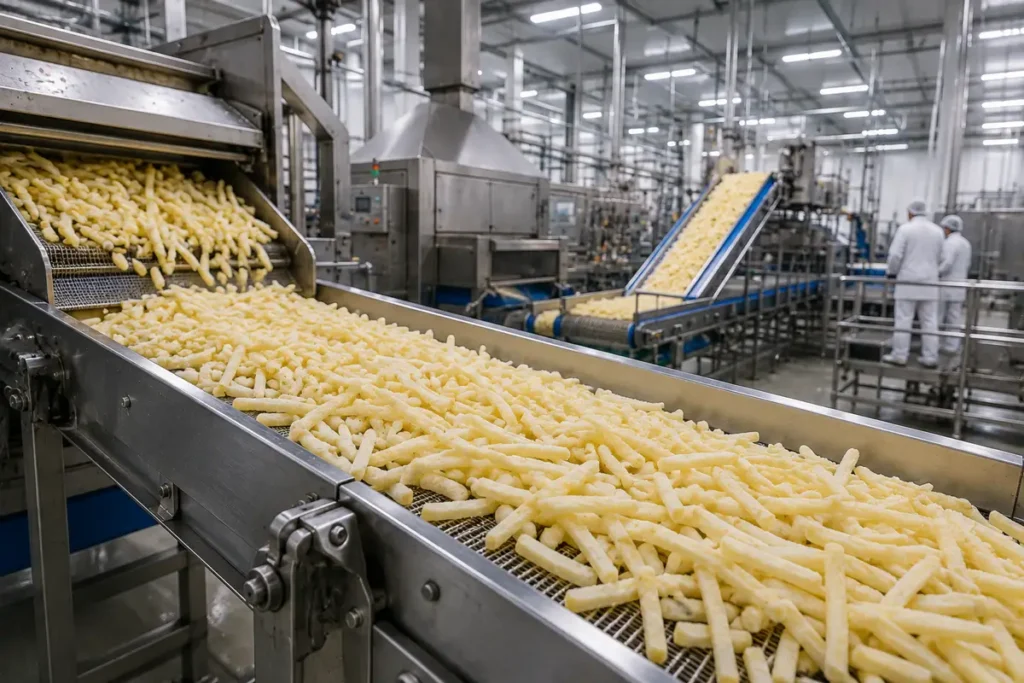
Four companies control almost the entire frozen french fry business in America. Lamb Weston, McCain Foods, J.R. Simplot and Cavendish Farms together hold 97 percent of the frozen potato products market.
That’s a remarkable amount of concentration for an industry that used to have more than a dozen serious players. Over the past two decades, smaller processors got bought out or squeezed out, leaving just four companies to supply nearly every fry that lands in a restaurant, grocery freezer or school cafeteria.
This guide profiles each of the major frozen french fries manufacturers in the USA, breaks down where they stand by market share and scale and rounds out the list with a few smaller companies still carving out space in specialty and retail segments.
Lamb Weston, the Market Leader
Lamb Weston holds roughly 40 percent of the frozen potato product market, the largest share of any single company. It’s based in Eagle, Idaho and runs more than 7,200 employees with annual revenue around $3.6 billion.
The company has been aggressive about capacity in recent years. In 2022, Lamb Weston announced a $415 million investment in a new french fry processing line in Idaho and it opened a new production facility in Argentina in 2025 to expand its reach into Latin America.
Lamb Weston supplies fries to a long list of major quick service chains and its scale lets it lock in potato supply contracts that smaller processors simply can’t match.
Also read: Top 10 Highest Potato Producing States in the US
McCain Foods, the Global Volume Leader
McCain Foods holds about 30 percent of the US market, but its real scale shows up globally. The Canadian company operates in more than 160 countries and pulls in roughly $7 billion in annual revenue with about 22,000 employees worldwide.
Founded in 1957 and headquartered in Ontario, Canada, McCain has spent heavily on expansion, including a CAD 600 million investment in Alberta and a EUR 350 million investment in France. It’s widely described as the market leader in frozen fries, potato specialties and appetizers on a global basis, not just within the US.
McCain also supplies fries directly to major quick service restaurant chains and industry reports consistently point to McCain’s fries as a leading choice among QSR customers.
You might also like
-
 McCain and Cargill Deepen Partnership in India’s Frozen Food Sector
 -
 US Firm Simplot Finalises Deal to Buy Belgian Frozen Fries Maker Clarebout
 -
 Fresh vs Processed Potatoes: Which Is More Profitable?
 -
 Innovation in Potato Processing: Turnkey Solutions from Fry and Bake
 -
 USA vs Canada Frozen French Fry Industry
 -
 Best Potatoes for French Fries in the USA: A Complete Guide
J.R. Simplot, the Idaho Original
J.R. Simplot holds around 20 percent of the market and has one of the longest histories in the business, founded in Boise, Idaho back in 1929. The company now operates in more than 50 countries with roughly 11,000 employees and about $6 billion in annual revenue.
One deal stands out here. In February 2022, Simplot signed an exclusive, multi-year agreement with Kraft Heinz that made Simplot the sole manufacturer of Ore-Ida products, while Kraft Heinz kept ownership of the Ore-Ida brand name itself. As part of that deal, Simplot took over the processing plant in Ontario Oregon.
Beyond fries, Simplot Foods produces a broad range of frozen potato, vegetable, fruit and grain products and it operates manufacturing facilities across the US, Canada, Mexico, China, Australia, India and Southeast Asia.
Cavendish Farms, the Smallest of the Big Four
Cavendish Farms rounds out the top tier with about 7 percent of the market. The company has roughly 18,100 employees and generates around $4.1 billion in annual revenue, supplying both retail and foodservice customers across North America.
Cavendish Farms has a strong presence in the frozen potato sector, with products ranging from traditional French fries to coated fries, specialty cuts, and other frozen potato products. Its broad customer base and production network make it one of the major frozen French fry suppliers in North America.
Also read: Top 10 Potato Producing Countries in the World
Smaller Manufacturers Worth Knowing
Below the big four, a handful of companies still compete in specific niches rather than head-to-head on volume. Bart’s Potato Company and Farm Frites International operate in the US market with a smaller footprint, often focused on private label and regional foodservice contracts.
Conagra Brands owns Alexia Foods, a smaller premium and organic focused frozen fry brand that competes on ingredient positioning rather than scale. European processors like Aviko and Agristo also ship product into the US, though their larger presence remains in European retail and foodservice markets.
None of these smaller players come close to touching the big four on volume, but they matter for buyers looking for organic certification, private label flexibility or specialty cuts that the major processors don’t always prioritize.
Market Snapshot: The Big Four Compared
| Company | US Market Share | Annual Revenue | Employees | Headquarters |
| Lamb Weston | ~40% | ~$3.6 billion | 7,200+ | Eagle, Idaho |
| McCain Foods | ~30% | ~$7 billion | 22,000 | Ontario, Canada |
| J.R. Simplot | ~20% | ~$6 billion | 11,000 | Boise, Idaho |
| Cavendish Farms | ~7% | ~$4.1 billion | 18,100 | New Brunswick, Canada |
Roughly 40 percent of all potatoes grown in the United States, about 17 billion pounds a year, get sold to frozen potato processors rather than the fresh market. That volume runs almost entirely through these four companies before it reaches a grocery freezer or restaurant fryer.
How the top frozen French fry manufacturers compare?
The best supplier depends on the type of operation. A restaurant focused on delivery may value hold time more than a supermarket buyer looking for a well-known household brand.
| Manufacturer | Strong point | Typical fit |
|---|---|---|
| Lamb Weston | Large foodservice range and fry performance | Restaurants, QSRs, chains |
| McCain Foods | Retail and foodservice variety | Restaurants and retail |
| J.R. Simplot | High-volume and specialty foodservice products | QSRs, schools, stadiums |
| Cavendish Farms | Coated and specialty fries | Restaurants and takeout |
The best fry is the one that fits the operation, not simply the one with the biggest name.
Also read: Best Potatoes for French Fries in the USA: A Complete Guide
What should buyers check before choosing a frozen fry supplier?
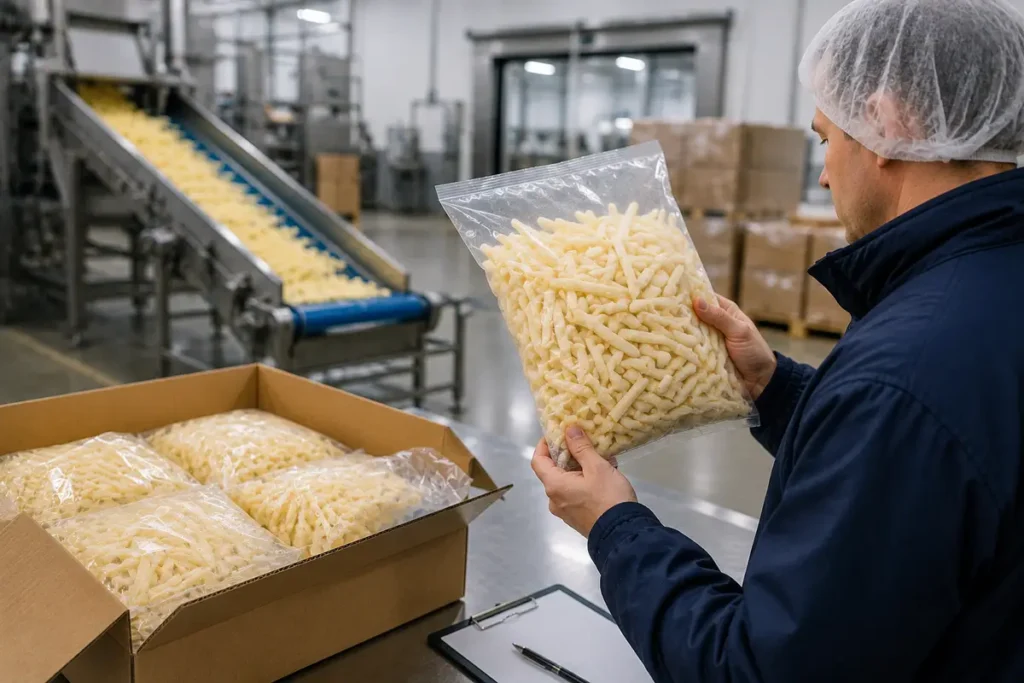
A 3/8 inch straight-cut fry can behave very differently from a coated shoestring or crinkle-cut product. That’s why buyers should compare the product specification, not just the brand.
For a restaurant, these factors matter most.
- Cut size and shape
- Coated or uncoated surface
- Skin-on or peeled
- Frying and baking requirements
- Hold time after cooking
- Pack size and case weight
- Storage requirements
- Product availability
- Customer taste and menu fit
- Cost per serving
For example, Simplot lists a 1/4 inch Infinity Fries product with a stated fry time of around 1.5 to 2 minutes at 345°F, while its product is also suitable for oven preparation. McCain’s standard 5/16 inch foodservice fries list a 2.5 to 3 minute frying time at 350°F.
Those differences matter in a busy kitchen because cooking time affects service speed, fryer use and consistency.
Why crispness and hold time matter
A fry can taste great when it comes out of the fryer and still perform poorly during delivery.
That has made coated fries more common in foodservice. Lamb Weston says its Crispy on Delivery fries can stay crispy for up to 30 minutes, while McCain promotes its SureCrisp products for takeout and delivery with a similar stated hold period.
Simplot has also developed products for this need. Its Conquest Delivery+ fries list a hold time of more than 40 minutes and are designed for both on-premise and off-premise orders.
For a burger restaurant with heavy delivery sales, that difference can matter a lot.
A simple way to choose the right manufacturer
Start with the menu rather than the brand.
If your restaurant serves classic burgers and fries, a conventional straight cut may be enough. If you rely heavily on delivery, a coated fry can make more sense. Schools may prefer products that work well in ovens, while high-volume QSRs may focus on quick cooking and consistent case yield.
The same supplier may offer several products that fit different needs. So it’s often better to request samples and test two or three cuts in the actual kitchen before placing a large order.
Also read: Fresh vs Processed Potatoes: Which Is More Profitable?
Frequently Asked Questions
-
Who is the largest frozen french fry manufacturer in the US?
Lamb Weston holds the largest share of the US frozen potato product market at roughly 40 percent, ahead of McCain Foods, J.R. Simplot and Cavendish Farms.
-
Does McCain Foods or Lamb Weston have more global reach?
McCain Foods operates in more than 160 countries and posts higher total revenue, while Lamb Weston holds a larger share specifically within the US market.
-
Who makes Ore-Ida frozen potato products?
J.R. Simplot manufactures Ore-Ida products under an exclusive agreement signed with Kraft Heinz in 2022, though Kraft Heinz continues to own the Ore-Ida brand name.
-
Are there any smaller or organic frozen fry brands in the US?
Yes, Conagra’s Alexia Foods focuses on premium and organic frozen fries and companies like Bart’s Potato Company serve smaller private label and regional contracts.
Image credit: Potato Insights
Sources:
- 4 Major Frozen French Fries Producers in Hot Oil for Market Control Conspiracy — The Samuel Vigil Newsletter
- The Rise of Big Potato — The Bittman Project
- Major Players – French Fries Industry — Coherent Market Insights
- Frozen Potato Product Market Insights 2025 — Research and Markets via Yahoo Finance
- The 13 Best Frozen French Fries Manufacturers — Keychain.com
Recent Articles


"Get the latest potato industry updates in Google Search. Add Potato Insights as a preferred source for potato markets, processing, trade and industry news."