India Frozen Potato Products Market Growth 2026: What’s Driving the Boom
India frozen potato products market growth: from USD 2.07B in 2025 to USD 9.95B by 2035. QSR expansion, exports, cold chain, and key players driving the 17% CAGR.
India’s frozen potato products market was valued at USD 2.07 billion in 2025. By 2035, it’s projected to reach USD 9.95 billion, nearly a fivefold increase. The CAGR driving that climb is 17%, one of the steepest growth rates anywhere in the global food industry. In 2026, that trajectory is well underway, and the factors behind it aren’t short-term noise. They’re structural shifts in how India eats, works, and spends.
India is the world’s second-largest potato producer, growing roughly 58.108 million tonnes of potatoes annually. For decades, most of that went into household cooking or starch production. The shift happened when processors, investors, and global QSR chains recognized the gap between raw production and value-added output.
The result is a processing boom, an export surge, and a domestic market that’s expanding in ways that were barely imaginable a decade ago. This article covers the full story behind India’s frozen potato market growth in 2026, who’s driving it, where it’s going, what products are leading, and what challenges still need solving.
Market Size and Growth Trajectory
The headline numbers vary slightly by research firm, but the direction is unanimous. Expert Market Research puts the 2025 value at USD 2.07 billion and projects 17% annual growth through 2035.
IMARC Group estimates USD 1.8 billion in 2024 with a CAGR of 10.3% through 2033. Research and Markets cites USD 2.0 billion in 2025, growing to USD 4.5 billion by 2034 at a 9.49% CAGR.
The spread between estimates reflects different product inclusions and methodology, but the consensus is clear: this market is growing faster than most food categories globally, and India is becoming one of the most important emerging markets for frozen potato products.
Why does this matter for 2026 specifically? Because 2026 is the year multiple investment decisions made between 2022 and 2024 start producing output. New processing plants are coming online. Cold-chain networks built in the post-pandemic infrastructure push are now operational.
And QSR chains that signed expansion deals during 2023 and 2024 are opening outlets across tier-2 and tier-3 cities where frozen potato demand was previously minimal.
Also read: Latest Trends in the Potato Snack Industry (2026)
India Frozen Potato Products Market: Key Data Points
You might also like
-
 Top 10 Potato Producing States in India by Production 2026
 -
 How Climate Change Is Affecting U.S. Potato Production
 -
 Complete Frozen French Fries Production Line Guide (2026)
 -
 Top 10 Potato Producing Countries in the World (2026)
 -
 Latest Trends in the Potato Snack Industry (2026)
 -
 Why Idaho Potatoes Are So Famous
| Indicator | Value |
|---|---|
| Market value (2025) | USD 2.07 billion |
| Market value (2035 forecast) | USD 9.95 billion |
| CAGR (2026–2035) | 17.00% |
| Market value (2024 alt. estimate) | USD 1.8 billion |
| French fry exports (2023-24) | 135,877 tonnes / Rs 1,478.73 cr |
| French fry exports (Apr–Oct 2024) | 106,506 tonnes |
| Export volume (2024-25) | 180,000+ tonnes (>40% surge) |
| India’s annual potato production | ~58.108 million tonnes |
| HyFun processing capacity | 250,000+ tonnes/year |
| India foodservice market (2029) | USD 125 billion (projected) |
Sources: Expert Market Research, IMARC Group, APEDA, GM Insights—2024-2026
QSR Expansion: The Single Biggest Growth Driver
Quick-service restaurants are the engine of frozen potato demand in India. When McDonald’s, KFC, Burger King, and Domino’s expand into a new city, frozen fry consumption in that city rises sharply. The connection is direct and well-documented.
QSRs and cloud kitchens in India are projected to grow at a CAGR of over 17% between 2025 and 2030, according to the Swiggy-Kearney How India Eats 2025 report. That’s a perfect parallel to the frozen potato market’s own growth rate, and it’s not a coincidence.
Frozen fries are a non-negotiable item on the menu of every major QSR chain operating in India, and they rely almost entirely on domestic processors for supply.
In May 2025, Devyani International launched the first New York Fries outlet in India at Mumbai Airport, bringing loaded fries into the Indian premium foodservice segment. That signals more than one brand entering a market.
It signals a new product format, premium customizable fries, gaining a foothold in a consumer culture already moving toward snacking and convenience eating.
India’s foodservice market is projected to grow from USD 70 billion to USD 125 billion by 2029. Even a modest share of that growth translates into enormous additional demand for frozen potato products.
India’s Export Surge: From Local Fields to 40+ Countries
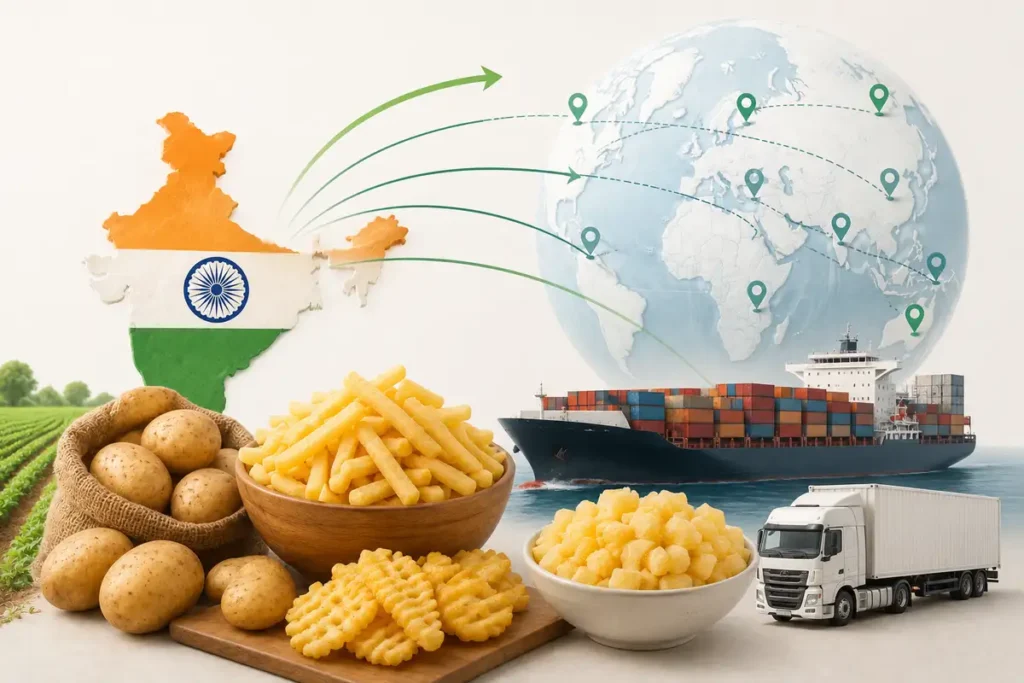
The domestic story is impressive. The export story is even more striking. In 2023-24, India exported 135,877 tonnes of frozen French fries worth Rs 1,478.73 crore. Between April and October 2024 alone, exports hit 106,506 tonnes. Over the full 2024-25 period, India’s frozen potato export volume crossed 180,000 tons, a surge of more than 40% in five years.
The CAGR on exports over the past several years exceeds 48%. That’s not a market finding its feet. That’s a category that has arrived.
Gujarat has been the primary hub, housing the processing facilities of HyFun Foods and Iscon Balaji Foods. Expansion is underway into Madhya Pradesh and Punjab. The Middle East, Southeast Asia, and parts of Africa are the key export destinations, regions where frozen food demand is growing and Indian processors can compete on both quality and price.
In February 2025, a joint venture between KRIBHCO and Netherlands-based Farm Frites was announced to establish a high-tech potato processing facility in Shahjahanpur, Uttar Pradesh. The collaboration will introduce premium Dutch potato varieties like Santana and Quintera to Indian farming, backed by agronomic support for local farmers. This is the kind of upstream investment that doesn’t just add capacity, it raises the quality ceiling for what Indian processors can produce.
Also read: Complete Frozen French Fries Production Line Guide
Key Players Shaping the Indian Market
Four companies dominate India’s frozen potato processing landscape, each with a distinct model and growth strategy.
McCain Foods India is the early entrant and category architect. The global giant works with over 10,000 Indian farmers through contract farming arrangements and built much of the early cold-chain and agronomic infrastructure that the sector runs on today. A USD 457 million facility expansion underlines ongoing commitment to India as a long-term strategic market.
HyFun Foods is India’s largest exporter of frozen potato products, processing over 250,000 tonnes per year and supplying global QSR chains. In February 2025, HyFun announced a partnership with UK-based HarvestEye to deploy AI-powered crop monitoring, integrating machine-learning vision systems with its Farmoji digital farmer platform for real-time crop quality insights. This is a company operating at global technology standards.
Iscon Balaji Foods is known for product range agility and has become a key exporter to the Middle East. In March 2024, HyFun and Iscon both made major investment announcements, with HyFun planning Rs 850 crore across three Gujarat plants to support a target of Rs 5,000 crore in annual revenue by 2028.
Falcon Agrifriz represents the next generation of Indian processing: automation-first, energy-efficient refrigeration, and waste-to-energy systems. It’s the model for what the sector increasingly looks like when new capacity is built from scratch.
Product Segments: French Fries Lead, But the Range Is Growing
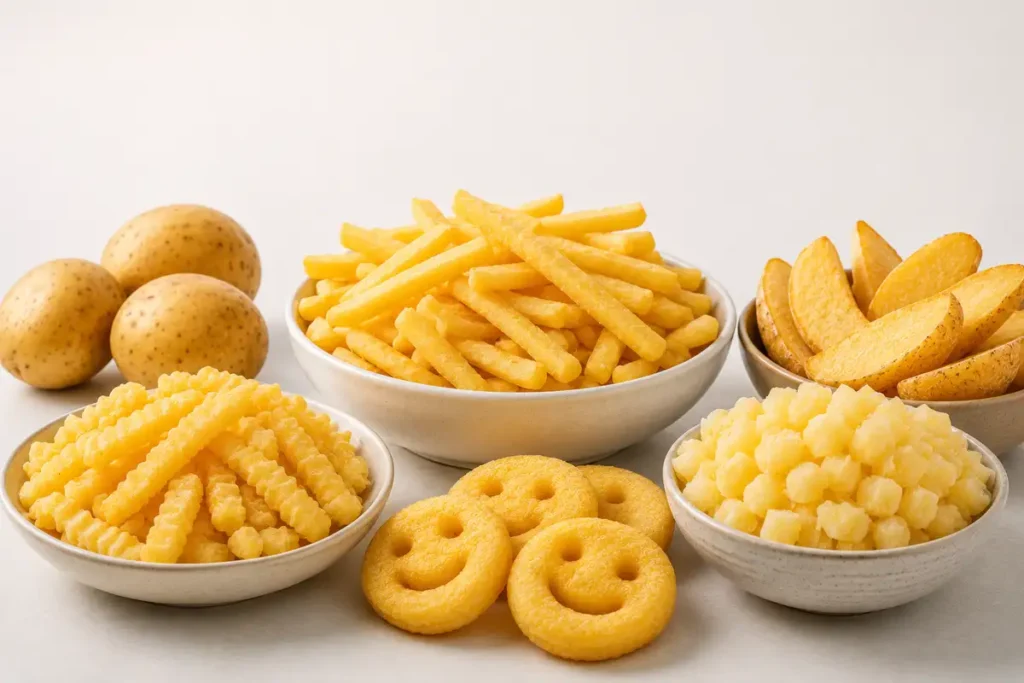
French fries are the dominant product in India’s frozen potato market, a position they hold across retail, foodservice, and export. They’re the item that QSR chains require in volume, that retail buyers recognize instantly, and that processors can produce efficiently at scale.
But the category is diversifying. Tikkis, potato wedges, potato bites, smileys, and hash browns are all growing segments. Indian-flavored innovations, masala variants, chaat-style bites, spiced wedges, are gaining traction both domestically and in export markets where Indian diaspora communities drive demand.
Product segments in India’s frozen potato market:
- French fries — dominant; institutional and retail
- Potato tikkis — strong domestic retail and foodservice demand
- Wedges — growing QSR and café adoption
- Smileys and bites — youth-oriented retail products
- Hash browns — rising with breakfast menus in urban outlets
- Indian-flavored innovations — masala, chaat, regional variants
Health-oriented variants are also entering the mix. Air-fried, low-oil, and reduced-sodium frozen potato products are being developed by brands responding to growing consumer awareness around healthier eating. This mirrors the global better-for-you trend and is likely to become a meaningful sub-segment in the coming years.
Also read: Potato Export from India: A Complete Guide
Cold Chain: The Infrastructure Gap Being Rapidly Closed
One of the biggest structural barriers to frozen food growth in India has historically been cold-chain infrastructure. Without reliable refrigerated storage and logistics, frozen products lose quality, shelf life, and consumer trust.
That gap is closing, but unevenly. Investment in cold storage capacity has accelerated post-pandemic, driven by government incentives, private capital, and the commercial pressure of companies like McCain and HyFun that need reliable supply chains.
Retail freezer penetration in supermarkets and modern trade outlets has improved significantly, making frozen products accessible in cities that previously had no reliable frozen food aisle.
Online food delivery penetration in India grew 12% in 2023 compared to 8% in 2019. That trend directly supports frozen potato retail, because delivery platforms require consistent product quality that only proper cold-chain handling can guarantee.
The challenges that remain are real: tier-3 city cold-chain coverage is still patchy, energy costs for refrigeration are a margin pressure, and skilled logistics labor is in short supply. These aren’t going away quickly. But the trend direction is clear — the infrastructure is being built, and the market is growing into it.
Urbanisation and the Changing Indian Consumer
Roughly 500 million Indians now live in urban areas, and that number is growing by 30 to 40 million people per year. Urban consumers have higher incomes, busier schedules, greater exposure to global food formats, and less time for traditional home cooking.
The nuclear family is displacing the joint family as the dominant household structure in Indian cities. Nuclear families, smaller, younger, often with dual incomes, are the primary buyers of convenience foods. Frozen potato products sit exactly at that intersection: quick to prepare, familiar in taste, available across price points, and well-suited to the Indian palate when producers invest in local flavor adaptation.
Young professionals aged 18 to 35 are the fastest-growing consumer segment for frozen potato products. This cohort grew up with QSR food, is comfortable with supermarket shopping, and uses food delivery apps as a daily habit. For brands targeting this group, frozen potato snacks are not a premium indulgence, they’re a routine part of eating.
This demographic shift is why the market’s growth projections remain so strong for the next decade. The structural consumer base is expanding, not just the current buyer pool.
Challenges the Industry Still Needs to Solve
India’s frozen potato market growth story is compelling, but it’s not without friction. Three challenges stand out as the most consequential for the sector’s long-term trajectory.
Potato variety suitability: Most table potato varieties grown in India are not ideal for processing. High-solids, low-sugar processing varieties are required for quality frozen fries, and India still relies heavily on imports and specialized domestic seed programs to get there. The KRIBHCO-Farm Frites joint venture directly addresses this by introducing Dutch varieties suited for processing.
Climate and agronomic risk: Potato yields in India are vulnerable to heat stress, erratic monsoons, and soil health degradation from intensive cropping. Ensuring consistent raw material supply for processing plants is an ongoing challenge. Contract farming models help, but they don’t eliminate weather-driven variability.
Consumer misconceptions: A segment of Indian consumers still associate frozen food with low nutritional value or chemical additives. This perception is being addressed through marketing, labeling improvements, and product innovation, but it slows adoption, especially in smaller cities and older demographics.
Also read: Top 10 Potato Producing States in India by Production
The Bottom Line on India’s Frozen Potato Market in 2026
India’s frozen potato products market is not a market waiting to grow. It is a market actively growing, right now, on the back of real investments, real consumption shifts, and real export demand. The USD 2 billion baseline of 2025 will look modest in retrospect.
The combination of QSR expansion, urbanisation, rising incomes, cold-chain investment, and a processing sector that is scaling rapidly puts India on a trajectory to become one of the world’s most important frozen potato markets. The export surge, crossing 180,000 tonnes in 2024-25, shows that Indian processors are now globally competitive, not just domestically relevant.
For businesses, investors, and industry observers watching this space, 2026 is not the beginning of the story. But it may well be remembered as the year the story became undeniable.
Frequently Asked Questions
-
What is the size of the India frozen potato products market in 2025?
The India frozen potato products market was valued at USD 2.07 billion in 2025, according to Expert Market Research. It is projected to grow at a CAGR of 17% between 2026 and 2035, reaching USD 9.95 billion by 2035.
-
What is driving frozen potato market growth in India?
The primary drivers are QSR expansion, urbanisation, rising incomes, growing convenience food adoption, cold-chain infrastructure investment, and strong export demand. QSRs and cloud kitchens in India are themselves projected to grow at over 17% CAGR between 2025 and 2030, directly boosting frozen potato demand.
-
Which companies lead India’s frozen potato products market?
The top four players are McCain Foods India, HyFun Foods, Iscon Balaji Foods, and Falcon Agrifriz. HyFun is India’s largest exporter, processing over 250,000 tonnes per year. McCain is the largest player by domestic market share and has the broadest contract farming network.
-
How much does India export in frozen potato products?
In 2024-25, India’s frozen potato export volume crossed 180,000 tonnes, a rise of more than 40% over five years. In 2023-24, India exported 135,877 tonnes of frozen French fries worth Rs 1,478.73 crore. The export CAGR over recent years has exceeded 48%.
-
What are the main challenges facing India’s frozen potato industry?
The three main challenges are the limited availability of processing-suited potato varieties domestically, climate and agronomic risk affecting raw material consistency, and persistent consumer misconceptions about frozen food quality in smaller cities and older demographic groups.
Image credit: Potato Insights
Sources:
- India Frozen Potato Products Market Report and Forecast 2026-2035 — Expert Market Research
- Top 4 Frozen Potato Products Companies in India 2026 — Expert Market Research Blog
- Indian Frozen Potato Products Market — IMARC Group
- India’s Frozen Potato Food Segment Among Fastest-Growing — NuFFoods Spectrum
- Sixfold in Five Years: India’s Frozen Potato Export Surge — India Business Trade
- India French Fries Market Forecast 2025-2034 — GlobeNewswire
- Frozen Potatoes Market Size & Share, Growth Trends 2025-2034 — GM Insights
- Indian Frozen Potato Products Market Size & Forecast to 2034 — Research and Markets
Recent Articles

"Get the latest potato industry updates in Google Search. Add Potato Insights as a preferred source for potato markets, processing, trade and industry news."