How Climate Change Is Affecting U.S. Potato Production
How climate change is affecting U.S. potato production: drought, heat stress, yield data by state and how farmers are adapting.
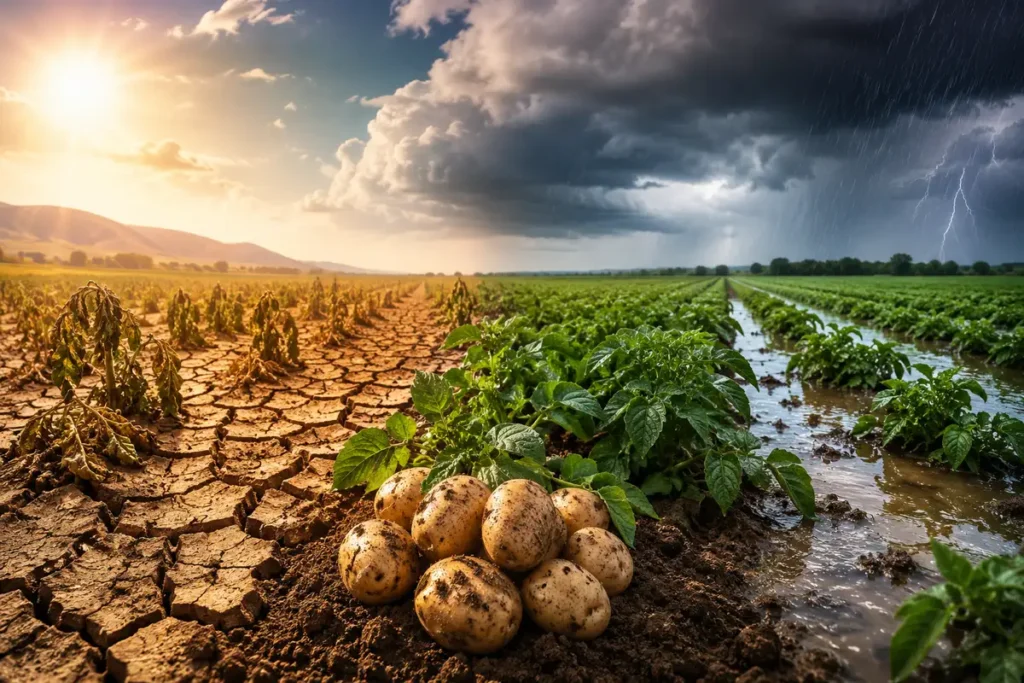
Climate change is reshaping U.S. potato farming. The 2024 harvest totaled 421 million hundredweight, down 4% from 2023, with growing conditions swinging sharply across states. Wisconsin had its worst yield since 2002 after spring flooding. Prices spiked 40% in 2022 after record droughts hammered Idaho and neighboring states the year before. These aren’t random bad years. They’re part of a pattern that researchers and growers have been tracking for years.
Potatoes are unusually sensitive to weather. They don’t like heat above 30 degrees Celsius, they need steady moisture during tuber formation and a single dry spell at the wrong time can cut yields significantly. With most U.S. potato production concentrated in just five western and northern states, any regional climate shift has an outsized effect on the entire national supply.
This article covers what’s actually happening to U.S. potato production because of climate change, which states are most at risk, how growers are responding and what the coming decades could look like for American potato farmers.
Why Potatoes Are So Vulnerable to Climate Stress
Most crops have some tolerance for rough conditions. Potatoes, not so much. The ideal growing temperature for potatoes sits between 16 and 19 degrees Celsius. Above 30 degrees, tuber formation slows or stops. Add water stress during that same window and you can lose a quarter of a field’s potential output in a matter of weeks.
The U.S. grows roughly 19.1 million tonnes of potatoes each year, mostly in Idaho, Washington, Wisconsin, Oregon and North Dakota. Those five states account for over 70% of national output. Idaho alone contributes about 32%, with Washington close behind at 24%.
Also read: Top 10 Potato Producing Countries in the World
That concentration is a problem.
When one region hits a drought or a heat event, there’s no geographic buffer. A bad summer in southern Idaho doesn’t get offset by a good one somewhere else, because the processing infrastructure, the contract farming networks and the dominant varieties are all clustered in the same places. The Eastern Snake Plain Aquifer, which supplies a big share of Idaho’s irrigation water, is already under pressure from decades of heavy withdrawals.
What’s Already Happening Across Key Producing States
The effects aren’t theoretical. They’re showing up in crop data right now.
Idaho’s potato growing season is expected to start earlier and run up to 20 days shorter by mid-century, according to the University of Idaho’s Climate-Economy Impacts Assessment. The state had 13 confirmed billion-dollar weather and climate disasters between 1980 and 2024, including 13 drought events and 15 wildfire events.
You might also like
-
 Potato Storage Diseases and Simple Prevention
 -
 India Potato Exports to Indonesia in 2025 – Market Trends & Price Outlook
 -
 Best Potato Farming Practices in India: From Planting to Harvest
 -
 Best Climate and Soil Conditions for Potato Farming
 -
 Top 10 Potato Producing States in India by Production 2026
 -
 U.S. Potato Acreage Falls 3% in 2026: What It Means
The annual rate of such events is accelerating: the five-year average from 2020 to 2024 runs 70% above the 1980 to 2024 long-term average.
The Northwest megadrought between 2020 and 2022 was the driest 22-year period south of the 45th parallel since 800 CE, according to the USDA Climate Hubs. What made it worse is that higher temperatures were responsible for 61% of its severity. It wasn’t just less rain. It was more evaporation, more soil moisture loss and more water demand from crops under heat stress.
Wisconsin tells a different story, but the same trend. Spring 2024 brought excessive rainfall that delayed planting, saturated soils and contributed to the state’s lowest average potato yield since 2002 at just 380 hundredweight per acre. That’s roughly 10% below the state’s five-year average. Too much water can be just as damaging as too little and climate change is making both extremes more likely.
Maine has its own vulnerabilities. An unprecedented drought in 2020 produced the state’s lowest potato yields in over two decades. Research published in the journal Climatic Change in 2025 confirmed that nighttime temperatures and heatwave duration in Aroostook County, Maine’s main potato region, have been rising steadily. Future yields there will depend more on irrigation access than ever before.
Also read: Best Climate and Soil Conditions for Potato Farming
U.S. Potato Production and Climate Change: Key Data
| Indicator | Value |
| US potato production (2024) | 421 million cwt / ~19.1M tonnes |
| Total farm-gate value (2024) | USD 4.60 billion |
| US 2024 yield (avg) | 454 cwt per acre (3rd highest on record) |
| Production change vs 2023 | Down 4% from 2023 |
| Idaho’s share of US output | ~32% (approx. 134M cwt) |
| Wisconsin 2024 yield | 380 cwt/acre (lowest since 2002) |
| Idaho growing season (forecast) | Up to 20 days shorter by mid-century |
| Drought events in Idaho (1980-2024) | 13 confirmed billion-dollar events |
| Projected global yield loss by 2035 | Up to 16% without adaptation |
| US potato price spike (2022) | Up 40% after 2021 record droughts |
Sources: USDA NASS 2024, NOAA NCEI, University of Idaho ICEIA, ClimateAi, IOPscience
Heat, Drought and What They Do to a Potato Crop
Here’s how the damage actually works. Potatoes need cool soil to set tubers. When soil temperatures climb, the plant shifts energy away from tuber production. Tubers that do form come out smaller, misshapen, or with quality defects that make them unsuitable for processing or fresh market.
Heat stress also speeds up the crop’s development cycle. The plant matures faster, but with less time to accumulate starch and dry matter. The result is lower yields and poorer processing quality, which matters enormously given that around 69% of all U.S. potatoes go to processors for frozen fries, chips and dehydrated products.
And the timing of stress is everything. A heat wave during tuber initiation in mid-summer is far more damaging than one in late spring. A dry spell right as tubers are expanding can cause hollow heart, a condition where the interior of the potato develops a cavity. Neither the processor nor the consumer wants that.
So what does all this mean for prices? When drought or heat cuts yields across the main producing states, prices move quickly. After the 2021 drought year, U.S. potato prices jumped roughly 40% in 2022. That kind of volatility is hard to plan around, especially for processors running on tight margins with pre-set contract prices.
Wildfire Smoke: A Lesser-Known but Real Threat
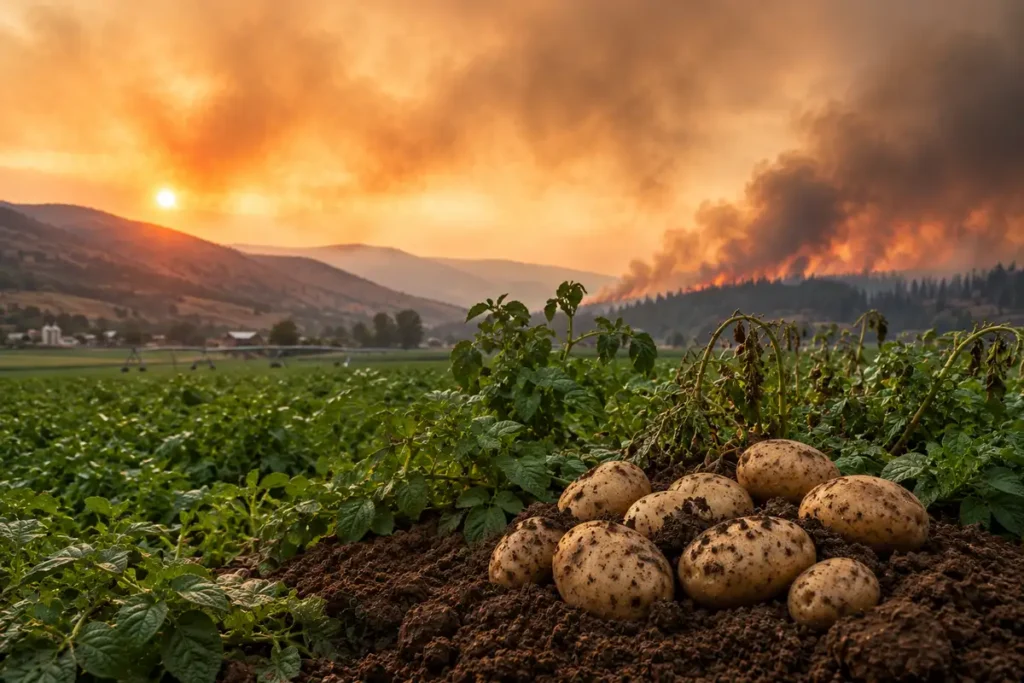
Drought and heat get most of the attention. But wildfire smoke is becoming its own issue in the Northwest.
Western Idaho, Oregon and Washington have seen fire seasons stretch longer and grow more intense over recent decades. Smoke reduces solar radiation reaching the crop, which slows photosynthesis and can delay maturity. It also deposits particulate matter on leaves, which affects the plant’s ability to regulate temperature and moisture.
Spud Smart, a Canadian potato industry publication, noted in early 2026 that wildfire smoke has become a ‘familiar backdrop’ to potato growing seasons across Western North America, raising ongoing questions about crop health, yield and quality. It’s not a catastrophic threat on its own, but it adds pressure to already stressed growing seasons. And it’s happening more often.
Also read: Idaho Potatoes vs Russet Potatoes – What’s the Real Difference?
More fires. Longer seasons. Less certainty at harvest time.
Idaho’s recent climate data bears this out. From 1980 to 2024, the state recorded 15 confirmed billion-dollar wildfire events and that count has been climbing in the most recent decade.
What the Research Says About Long-Term Yield Losses
The research picture is consistent, even if the exact numbers vary by model.
One widely cited study projects global potato yields could fall by up to 16% by 2035 without adaptation measures and up to 85% by 2085 under a high-emissions scenario. That’s the outer end of a worst-case range, but even the moderate projections are concerning.
Separate modeling work estimates global yield declines of 18% to 32% between now and 2040 to 2069 without adaptation and 9% to 18% with adaptation measures factored in.
For the U.S. specifically, the picture is mixed by region. The Pacific Northwest and Idaho could see shorter growing seasons but also faster-warming springs, which shifts planting windows. Parts of the northern U.S., including some areas of Maine and northern states, may actually see longer growing seasons as winters warm. But the dominant production regions in southern Idaho and central Washington sit in the zone most exposed to increased drought and heat stress.
One thing the research makes clear: potatoes grown above 30 degrees Celsius don’t perform well, full stop. As average summer temperatures rise in the major growing regions, the number of days crossing that threshold is increasing. That’s not a model prediction. It’s already in the historical temperature record.
How U.S. Growers Are Adapting
Growers aren’t waiting for conditions to stabilize. Adaptation is already underway across the industry and it comes in several practical forms.
Irrigation efficiency is probably the most immediate response. Many Idaho and Washington growers have shifted toward drip irrigation systems that deliver water directly to the root zone, cutting waste and reducing the evapotranspiration losses that make drought worse.
Better soil moisture sensors and satellite-based crop monitoring help growers use water more precisely. Given that the Eastern Snake Plain Aquifer is under long-term pressure, that kind of efficiency isn’t optional. It’s necessary.
Planting schedule adjustments are another tool. Starting earlier in the season, when soil temperatures are still cool, helps tubers form before summer heat peaks. Some growers in warmer areas are also shifting toward varieties that mature faster, allowing them to harvest before the worst heat arrives.
Main adaptation strategies in use across U.S. potato regions:
- Drip and precision irrigation to reduce water use and heat stress
- Earlier planting to avoid peak summer temperatures
- Heat and drought-tolerant variety trials and adoption
- Cover cropping and mulching to improve soil moisture retention
- AI-based crop monitoring for real-time risk assessment
- Geographic diversification into cooler northern growing regions
On the technology side, companies like HarvestEye (partnered with HyFun Foods in India) and ClimateAi are building AI tools that give growers real-time weather risk data and growing degree day forecasts. While much of this innovation is focused internationally right now, the tools are directly applicable to U.S. operations.
The seed breeding side is moving too, with programs working on varieties better suited to warmer, drier conditions.
There’s also a quiet geographic shift happening. Cooler areas in northern U.S. states, southern Canada and higher elevations are becoming more viable for potato production as warming extends the frost-free season. It’s not a solution, but it’s a real structural shift that’s already being discussed among industry planners.
Also read: Top 10 Highest Potato Producing States in the US
What the Industry Needs to Tackle Next
Adaptation is happening, but it’s uneven. Large commercial operations in Idaho and Washington have the capital to upgrade irrigation systems, run variety trials and access forecasting tools. Smaller growers in Maine, Wisconsin and Colorado often don’t.
The aquifer question is serious and doesn’t have an easy answer. The Eastern Snake Plain Aquifer is the backbone of Idaho potato production. It’s recharged slowly by snowpack and groundwater flows. As snowpack patterns change with warmer winters and earlier spring melts, recharge rates are uncertain.
Pumping efficiency helps, but it doesn’t solve the underlying supply math if the aquifer keeps drawing down faster than it refills.
Variety development is another gap. Current commercial potato varieties have a narrow genetic base, which makes breeding for stress tolerance slow. Wild potato relatives from the Andes carry resistance traits that could be bred into commercial lines, but that work takes years and significant investment. The industry needs that pipeline moving faster than it currently is.
The Road Ahead for U.S. Potato Farmers
U.S. potato production is already feeling climate pressure and the data shows it clearly. A 4% drop in 2024 output, Wisconsin’s worst yield in two decades, Idaho’s shorter growing seasons, the 2022 price spike after drought. These aren’t isolated events. They’re early signals of a longer-term shift.
The good news is that the U.S. potato industry is not starting from zero. It has world-class irrigation infrastructure, strong processing partnerships and a farming culture that’s genuinely adaptive. The precision agriculture tools, variety research and climate forecasting resources available to growers today are far more sophisticated than they were even ten years ago.
But technology and adaptation only help if they’re deployed broadly and early. The concentration of U.S. production in a handful of drought-prone western states is a real structural risk. Growers, processors, policymakers and researchers all have work to do and the window for getting ahead of the problem, rather than just reacting to it, is still open. For now.
Frequently Asked Questions (FAQs):
-
How is climate change affecting U.S. potato production right now?
Total U.S. production fell 4% in 2024 vs 2023. Drought years like 2021 pushed prices up 40% the following year. Wisconsin hit its lowest yield since 2002 in 2024 due to spring flooding. Idaho’s growing season is projected to shorten by up to 20 days by mid-century, per the University of Idaho.
-
Which U.S. states face the biggest climate risk for potato farming?
Idaho and Washington carry the highest risk because they produce roughly 56% of all U.S. potatoes and rely heavily on irrigation from an aquifer under long-term pressure. Wisconsin faces increasing flooding risk and Maine has seen drought-driven yield losses. The Pacific Northwest megadrought of 2020 to 2022 was the region’s driest stretch in 1,200 years.
-
What temperature is too hot for potato crops?
Potato tuber formation slows significantly above 30 degrees Celsius. Sustained heat at that level reduces yield, lowers starch content and causes quality defects like hollow heart. As average summer temperatures rise in U.S. growing regions, the number of days crossing this threshold is increasing each decade.
-
How much could climate change reduce potato yields long-term?
Research projects global potato yield losses of 18% to 32% by 2040 to 2069 without adaptation. With adaptation, that range drops to 9% to 18%. One study projects losses of up to 16% by 2035 under current trajectories. U.S. yields will vary significantly by region, with cooler northern areas potentially gaining growing season length while the Pacific Northwest faces greater drought exposure.
Image credit: Potato Insights
Data source:
- USDA NASS 2024 Potato Summary Report
- How Climate Change Threatens Potato Supply Chains – ClimateAi
- Past and Future Changes in Potato Production Vulnerabilities in Maine – Climatic Change, Springer
- Drought and Climate Change in Idaho, Oregon and Washington – USDA Climate Hubs
- Idaho Climate-Economy Impacts Assessment – University of Idaho
- Billion-Dollar Weather and Climate Disasters: Idaho Summary – NOAA NCEI
- Climate Change Impacts on Global Potato Yields: A Review – IOP Science / Environ. Res.: Climate
Recent Articles

"Get the latest potato industry updates in Google Search. Add Potato Insights as a preferred source for potato markets, processing, trade and industry news."