
How to Transport Frozen French Fries: Cold Chain Guide
Learn how to transport frozen French fries at -18°C, including reefer loading, pre-cooling, packaging, temperature monitoring and export cold-chain tips.

Frozen French fries should be transported as a temperature-controlled product, with the cold chain kept at -18°C or colder as the main product target. The fries should already be properly frozen before loading and the reefer truck or container should be pre-cooled before the cargo goes inside.
For exporters, distributors and foodservice buyers, the biggest risks are temperature fluctuations, slow loading and unloading, poor airflow, damaged packaging and delays at ports or warehouses.
A well-planned cold chain helps protect the texture, appearance, packaging and shelf life of the fries.
What temperature should frozen French fries be transported at?
The commonly used cold-chain target for quick-frozen foods is -18°C or colder. Codex guidance says quick-frozen foods should be transported in suitable insulated equipment that can maintain a product temperature of -18°C or colder. The product should also be at the required frozen temperature when transport begins.
A brief temperature rise may be allowed under some national rules, but this should not be treated as normal operating practice. The product should be returned to the required temperature as soon as possible.
For international shipments, the exact legal requirements can depend on the countries involved. The UNECE ATP system, for example, sets technical and temperature requirements for certain international movements of frozen and quick-frozen foods between participating countries.
Also read: Best Frozen French Fries Manufacturers in the USA
How the frozen French fries cold chain works
A typical commercial shipment follows this path:
Processing plant → Frozen cold store → Reefer truck → Port or distribution centre → Reefer container → Destination port → Cold store → Distributor → Foodservice or retail
Every transfer is a possible temperature-risk point.
You might also like
-
 4,000 Tons of Potatoes to Be Shared Free in Berlin
 -
 U.S. Potato Industry Disappointed Over Japan’s Ongoing Market Block
 -
 Global Potato Market Faces Supply Gluts, Weather Shocks and Falling Prices
 -
 Cuttack Farmers Hesitant to Grow Potatoes This Season
 -
 Tajikistan Shows Higher Potato Output and Focuses on Better Storage
 -
 Top Countries Importing American Potatoes (2026)
The aim is simple. Keep the fries frozen, reduce exposure to warmer air and move the product quickly between controlled-temperature areas.
1. Freeze and store the fries before transport
French fries should enter the transport chain already frozen to the required product temperature. A refrigerated vehicle is mainly designed to maintain the cargo condition during transport, not to rapidly freeze warm product.
The product should be stored in a suitable frozen cold room before dispatch. Temperature records should be maintained so the shipper can show that the product was held under the required conditions.
2. Pre-cool the reefer
The refrigerated truck or container should be pre-cooled before loading.
This matters because a warm trailer or container can add heat to the cargo during the first part of the journey. Codex guidance specifically recommends pre-cooling transport compartments before loading quick-frozen foods.
The vehicle should also be clean, free from unwanted odours and in good condition. Door seals, insulation, refrigeration equipment and the internal air circulation system should be checked before loading.
3. Load quickly and keep the doors closed
Frozen fries should spend as little time as practical outside temperature-controlled areas.
The loading area should be organised before the reefer doors are opened. Pallets or cartons should be ready, documents should be prepared and loading equipment should be available.
Once loading is complete, close the doors quickly and start the transport operation without unnecessary delay.
A cold chain can fail during a short loading delay even when the refrigeration unit itself is working correctly.
How to load frozen French fries in a reefer
Good loading is not simply about fitting as many cartons as possible into the container. Cold air needs to circulate around the cargo.
Codex guidance recommends effective stowage that protects the cargo from heat entering from outside and allows the refrigeration system to operate properly.
For palletised frozen fries:
- Keep the load within the reefer’s marked loading limits.
- Do not block the designed air circulation paths.
- Avoid loading patterns that prevent cold air from reaching the cargo.
- Keep cartons stable to reduce crushing and movement.
- Follow the reefer manufacturer’s loading instructions.
- Avoid unnecessary empty spaces that interfere with the intended airflow pattern.
- Do not allow damaged cartons or leaking packages into the shipment.
The exact loading pattern depends on the reefer design, pallet size, carton dimensions and transport route.
Also read: Best Potato Varieties for Crinkle Cut French Fries in the USA
Packaging for frozen French fries
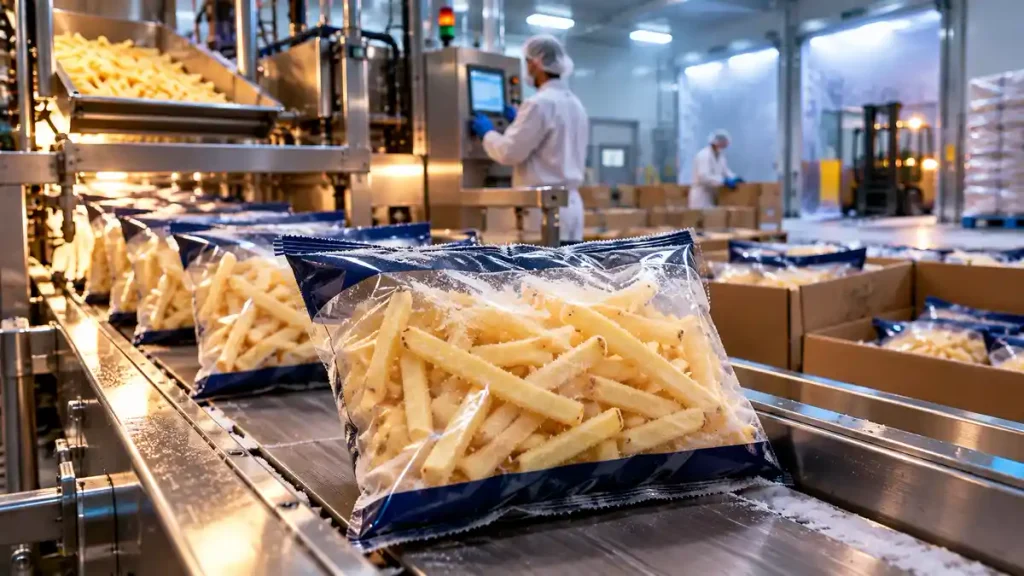
Packaging has two jobs. It must protect the fries and help maintain product quality during handling and transport.
Retail and foodservice fries may use different bag and carton formats, but packaging should generally protect the product from moisture, contamination, physical damage and excessive temperature exposure.
Damaged cartons can create problems during pallet handling and may expose inner bags to moisture or physical damage.
Palletisation also makes loading, unloading, warehouse storage and inventory handling faster. The pallet configuration should be tested with the actual carton dimensions rather than based only on a standard pallet pattern.
Temperature monitoring during transport
The reefer display gives the operator useful information, but a shipment should also have a way to record temperature over time when the shipment requires documented monitoring.
A temperature logger can help show what happened during the journey.
For commercial shipments, records can be useful at several points:
- Product temperature before loading
- Reefer temperature before loading
- Temperature during transport
- Temperature at delivery
- Temperature after arrival at the destination cold store
The shipper and carrier should agree in advance on the required temperature range, monitoring method and procedure for handling a temperature excursion.
Ocean transport of frozen French fries
For international exports, frozen French fries are commonly moved in refrigerated containers, also known as reefers.
The container should be prepared and pre-cooled before stuffing. The frozen cargo should be loaded at the required temperature and the container should remain connected to an appropriate power supply during the refrigerated stages of the journey.
Port handling deserves particular attention. Delays during container transfer, customs clearance, inspection or inland transport can create additional exposure to temperature risk.
For longer routes, the shipping plan should consider:
- Port dwell time
- Transshipment points
- Reefer power availability
- Destination clearance time
- Final delivery distance
- Availability of frozen storage at destination
The buyer and seller should also agree who is responsible for temperature monitoring and what records are required at handover.
Also read: Best Potatoes for French Fries in the USA: A Complete Guide
Common cold-chain mistakes
Several problems can reduce the quality of frozen French fries during transport.
Loading warm product
A reefer may struggle to bring warm cargo back to the required frozen condition. Product should be properly frozen before loading.
Poor airflow
Overloading or blocking designed air paths can create temperature differences within the cargo.
Long door openings
Every door opening allows warmer air into the refrigerated space. Loading and unloading should therefore be planned and completed quickly.
Weak packaging
Crushed cartons, torn bags and moisture exposure can create quality and handling problems even when the temperature remains controlled.
No temperature records
Without a temperature record, it can be difficult to determine where a cold-chain problem occurred.
Poor destination planning
A container can arrive at the port in good condition but still face problems if clearance, unloading or delivery to the destination cold store takes too long.
Frozen French fries transport checklist
| Checkpoint | What to verify |
|---|---|
| Product | Already frozen to the required temperature |
| Cold store | Stable frozen storage before dispatch |
| Reefer | Clean, insulated and suitable for frozen cargo |
| Pre-cooling | Transport compartment pre-cooled before loading |
| Loading | Fast loading with correct airflow |
| Packaging | Bags and cartons protected from damage and moisture |
| Monitoring | Temperature recorded during the journey |
| Documentation | Shipping and temperature records available |
| Port handling | Reefer power and transfer arrangements confirmed |
| Destination | Frozen storage ready before arrival |
What happens if frozen fries get too warm?
Temperature abuse can reduce frozen-food quality. Repeated temperature rises and re-cooling can contribute to moisture migration, frost formation, dehydration and other quality changes.
For French fries, this can affect the condition of the product before it reaches the fryer. The exact effect depends on the temperature, duration of exposure, product formulation, packaging and previous temperature history.
If a shipment has a temperature excursion, the product should be assessed against the applicable product specification and local requirements rather than automatically being accepted or rejected.
Also read: How Are Crinkle Cut French Fries Made? Factory Process Explained
Conclusion
Transporting frozen French fries safely is mainly a matter of maintaining a stable cold chain from the processing plant to the final cold store. Keep the product properly frozen, pre-cool the reefer, load quickly, protect airflow, monitor temperature and plan port and destination handling before the shipment leaves.
For exporters, the most useful approach is to treat temperature control as a complete chain rather than a single refrigeration setting. Every handover, loading operation, port delay and warehouse transfer needs to protect the same frozen condition.
FAQs
-
What temperature should frozen French fries be transported at?
The main cold-chain target for quick-frozen foods is -18°C or colder. Follow the product specification and applicable national requirements.
-
Can frozen French fries be transported in a normal truck?
For commercial frozen shipments, use suitable insulated and refrigerated transport that can maintain the required frozen temperature.
-
Should a reefer container be pre-cooled?
Yes. Codex guidance recommends pre-cooling the transport compartment before loading quick-frozen foods.
-
Do frozen fries need temperature monitoring?
For commercial shipments, temperature monitoring provides useful evidence that the cold chain was maintained and can help identify problems during transit.
-
Can frozen French fries be shipped by sea?
Yes. Frozen fries can be transported internationally in refrigerated containers, provided the cold chain, reefer operation, port handling and destination storage are properly planned.
Image credit: Potato insights
Sources & references:
- Code of Practice for the Processing and Handling of Quick Frozen Foods, CXC 8-1976 — FAO/WHO Codex Alimentarius
- Agreement on the International Carriage of Perishable Foodstuffs and on the Special Equipment to Be Used for Such Carriage, ATP — UNECE
- Transport of Perishable Foodstuffs — UNECE
- What is the right temperature for the freezer? — USDA Food Safety and Inspection Service Ask
- Transport of Perishable Foods by Truck — USDA Agricultural Marketing Service
- Guidance for Industry: Sanitary Transportation of Food — U.S. Food and Drug Administration
Recent Articles


"Get the latest potato industry updates in Google Search. Add Potato Insights as a preferred source for potato markets, processing, trade and industry news."