Top 10 Potato Producing Countries in Africa
Which African countries produce the most potatoes? The latest available data puts Egypt at the top, followed by Algeria and Ethiopia. See the full top 10 ranking and production figures.
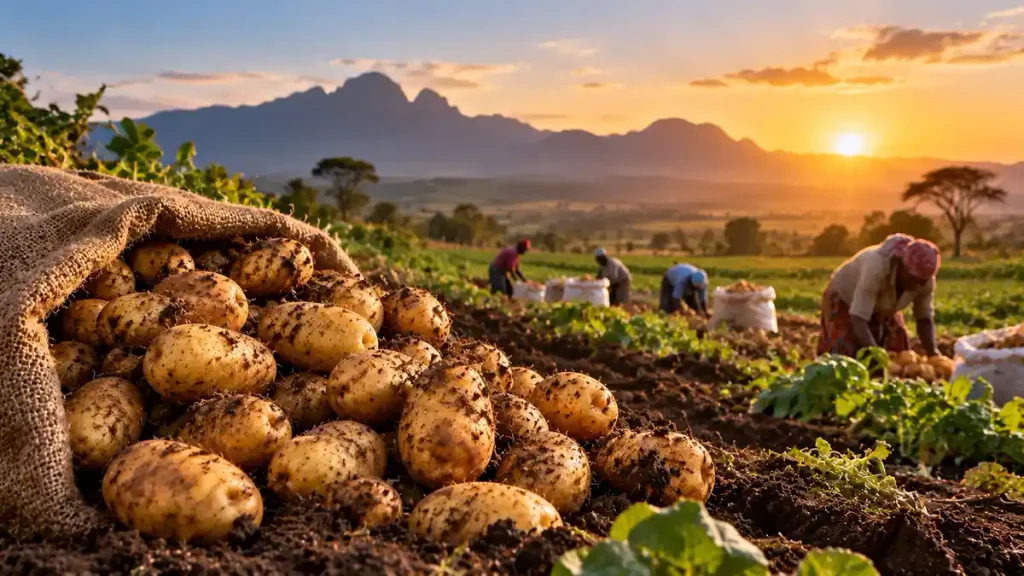
Africa produced about 34.2 million tonnes of potatoes in 2024, according to the latest FAOSTAT production data. Egypt was the largest producer, followed by Algeria and Ethiopia. Africa is a major potato-producing region, with several countries producing millions of tonnes each year. Egypt is the largest producer, followed by Algeria and Ethiopia, while South Africa, Morocco and Kenya are also among the continent’s leading producers.
Potato production varies widely across Africa because of differences in climate, farming systems, irrigation, seed quality and growing conditions. These differences also shape opportunities for potato processing, storage, packaging, equipment and trade.
The ranking below looks at the leading potato-producing countries in Africa using the latest comparable production data available from FAOSTAT.
Top Potato Producing Countries in Africa
| Rank | Country | Potato production, 2024 |
|---|---|---|
| 1 | Egypt | 8.08 million tonnes |
| 2 | Algeria | 4.60 million tonnes |
| 3 | Ethiopia | 4.09 million tonnes |
| 4 | South Africa | 2.62 million tonnes |
| 5 | Morocco | 2.19 million tonnes |
| 6 | Kenya | 2.19 million tonnes |
| 7 | Malawi | 1.46 million tonnes |
| 8 | Nigeria | 1.23 million tonnes |
| 9 | Rwanda | 827,355 tonnes |
| 10 | Zimbabwe | 673,484 tonnes |
Also read: Top 10 Potato Producing Countries in the World
1. Egypt
Egypt is Africa’s largest potato producer, with 8.08 million tonnes produced in 2024. Its output was almost twice that of Algeria, the second-largest producer.
Egypt’s potato industry is important for both domestic supply and international trade. Potato production is supported by irrigated agriculture and the country has developed a significant fresh potato export sector.
The scale of Egyptian production also makes the country important for businesses supplying potato seed, agricultural equipment, grading systems, storage facilities, packaging and processing equipment.
2. Algeria
Algeria produced 4.60 million tonnes of potatoes in 2024, placing it second in Africa. Production declined slightly from 4.66 million tonnes in 2023.
Potato production is spread across different agricultural areas, including irrigated production in the country’s northern and southern regions. Algeria has also become an important potato-producing country in the wider North African market.
3. Ethiopia
Ethiopia recorded 4.09 million tonnes of potatoes in 2024, making it Africa’s third-largest producer. Production increased from 4.03 million tonnes in 2023.
You might also like
-
 New Potato Storage Site Opens in West Kazakhstan
 -
 Ben Sklarczyk Elected 2026 National Potato Council President
 -
 National Potato Fair 2026 Held in Modipuram
 -
 Best Potato Varieties for Indian Farmers in 2026
 -
 UK Potato Growers Set for Packed Conference in Dundee
 -
 Scientists in Punjab, Pakistan, Developed Smog-Tolerant Potatoes
Ethiopia is particularly important in East Africa. Potatoes are grown in several highland areas where the climate supports production. The crop is also linked to food security and rural incomes.
The country’s production volume is large, but productivity remains an important issue. This creates potential demand for better seed, crop management, storage and post-harvest systems.
4. South Africa
South Africa produced 2.62 million tonnes of potatoes in 2024. Output increased 8.6% from the previous year and was close to the country’s recent production highs.
South Africa has a well-developed commercial potato sector serving fresh markets and food processing. Its production system also has comparatively high yields, making it an important benchmark for potato production in Africa.
For the wider potato industry, South Africa is relevant for processing, fresh-market supply, agricultural technology and equipment.
5. Morocco
Morocco produced 2.19 million tonnes of potatoes in 2024. Production increased by 21.8% from 2023 and reached the highest level in the available FAOSTAT series.
Morocco is one of North Africa’s major potato-producing countries. Its position close to European markets also gives its agricultural sector an important connection with international food trade.
Also read: Top 10 Highest Potato Producing States in the US
6. Kenya
Kenya produced about 2.19 million tonnes of potatoes in 2024, placing it sixth in Africa. FAOSTAT-based figures put production at 2,188,110 tonnes.
Potatoes are an important food and cash crop for Kenyan farmers. Production is concentrated in major potato-growing regions, particularly the country’s highland areas.
Kenya also has a large harvested area compared with many other African producers. This means improvements in seed quality, farm productivity, storage and marketing can have a significant effect on the sector.
7. Malawi
Malawi produced about 1.46 million tonnes of potatoes in 2024. Production declined 3.9% from 2023, when output was about 1.52 million tonnes.
Potatoes are an important crop in Malawi, particularly for farmers operating in suitable highland areas. The country’s production level places it among Africa’s major potato-producing markets despite being considerably smaller than Egypt, Algeria and Ethiopia.
8. Nigeria
Nigeria produced approximately 1.23 million tonnes of potatoes in 2024, according to the FAOSTAT-based figures.
Nigeria’s potato industry is concentrated mainly in the country’s cooler highland production areas, with Plateau State being an important production centre. A 2025 sector report using FAOSTAT data estimated annual production at about 1.22 million tonnes.
The country’s large population also creates a substantial domestic market for fresh and processed potato products.
9. Rwanda
Rwanda produced 827,355 tonnes of potatoes in 2024. FAOSTAT-based data show production declined by about 4.4% from the previous year.
Potatoes are particularly important in Rwanda’s highland farming systems. National agricultural data also show that Irish potato production reached about 461,000 tonnes in the 2024 agricultural year under Rwanda’s national reporting system, illustrating that production figures can vary between national and internationally harmonized datasets.
For international comparisons, the FAOSTAT series provides a consistent basis across countries.
10. Zimbabwe
Zimbabwe produced 673,484 tonnes of potatoes in 2024, according to the FAOSTAT-based African ranking.
The country completes the top 10 African producers in the latest available production ranking. Zimbabwe’s potato sector serves domestic food markets, while local production also has relevance for the country’s food-processing industry.
Also read: Potato Consumption Per Capita by Country
What does Africa’s potato production tell us?
The production figures show a clear concentration of potato output among a relatively small group of countries.
Egypt, Algeria and Ethiopia together produced more than 16.7 million tonnes in 2024. That represents almost half of Africa’s total potato production of about 34.2 million tonnes.
There is also a strong regional pattern. North Africa has major producers in Egypt, Algeria and Morocco, while East and Southern Africa include Ethiopia, Kenya, South Africa, Malawi and Rwanda.
Production volume, however, does not tell the whole story. Harvested area, yield, seed quality, irrigation, storage, processing capacity and access to markets can all affect the value of a country’s potato sector.
For example, Ethiopia’s production volume is high, but its average yield remains much lower than that of countries such as South Africa. This shows why production growth and productivity growth are two different measures for the potato industry.
Africa’s potato industry in 2026
For 2026 research, it is important to use the 2024 production year rather than presenting an unverified 2025 or 2026 production figure as fact.
FAOSTAT’s latest agricultural production dataset currently covers crop production through 2024. The database uses national statistics and other official sources, with production reported in tonnes.
The next FAOSTAT agricultural production update is scheduled for December 2026. That release may provide newer production data for comparison.
For companies watching the African potato market, the main areas to follow include production growth, yield improvement, seed supply, irrigation, storage, processing and regional trade.
Conclusion
Egypt remains Africa’s largest potato producer based on the latest available FAOSTAT data, with 8.08 million tonnes in 2024. Algeria and Ethiopia followed with 4.60 million and 4.09 million tonnes respectively.
South Africa, Morocco and Kenya formed the next group, while Malawi, Nigeria, Rwanda and Zimbabwe completed the top 10.
For potato businesses, these countries provide a useful starting point for studying Africa’s production capacity, processing demand, agricultural equipment markets and future supply chains.
Also read: Why the Netherlands Leads the Global Potato Industry
FAQs
-
Which country produces the most potatoes in Africa?
Egypt produced the most potatoes in Africa, with 8.08 million tonnes in 2024 according to FAOSTAT-based data.
-
Which are the top three potato producing countries in Africa?
The top three were Egypt, Algeria and Ethiopia, with 8.08 million, 4.60 million and 4.09 million tonnes respectively in 2024.
-
How much potatoes does Africa produce?
Africa produced about 34.2 million tonnes of potatoes in 2024 according to the latest FAOSTAT production data.
-
Is Kenya a major potato producer in Africa?
Yes. Kenya produced about 2.19 million tonnes in 2024 and ranked sixth in the FAOSTAT-based African production ranking.
-
What is the latest year of potato production data available for Africa?
The latest comparable FAOSTAT crop-production data currently available is for 2024. FAO’s next agricultural production update is planned for December 2026.
Image credit: Potato insights
Sources & references
- Agricultural production statistics 2010–2025, December 2025 update — Food and Agriculture Organization of the United Nations
- Crop production, yield, harvested area, Global and National Annual — FAOSTAT
- Potato Production and Consumption in Africa — PotatoPro
- Potato Production in Egypt — Helgi Library, based on FAOSTAT
- Potato Production in Algeria — Helgi Library, based on FAOSTAT
Recent Articles

"Get the latest potato industry updates in Google Search. Add Potato Insights as a preferred source for potato markets, processing, trade and industry news."