
Potato Storage Costs in the USA: Investment, Energy Use and Losses
How much does potato storage really cost after electricity and crop losses? See the main investment factors, energy calculations and practical ways US growers can assess storage profitability.
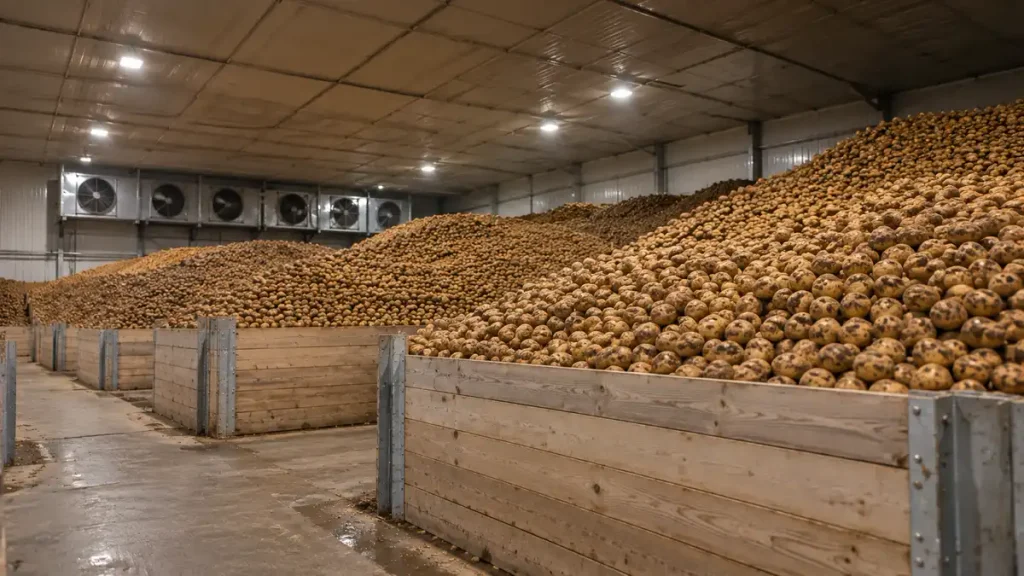
Commercial potato storage is a major operating investment for US growers, processors and potato distributors. The total cost depends on storage capacity, building design, ventilation and refrigeration equipment, electricity rates, storage duration and the amount of crop lost before sale.
A profitable storage operation must balance construction and operating costs against the value of potatoes preserved and the price they can earn later.
There is no single construction price or annual storage cost that applies to every US potato facility. The most useful way to assess an investment is to calculate the cost per US short ton stored, measure energy use and estimate how much marketable product remains after storage.
How Much Does Commercial Potato Storage Cost?
Building a commercial potato storage facility in the USA can require a substantial investment. The final cost depends on storage capacity, building design, insulation, ventilation, refrigeration, site preparation and handling equipment.
As a general reference, US Cold Storage Builders published a 2026 construction benchmark of $155 to $215 per square foot for refrigerated warehouses. This figure covers general cold-storage construction, not a dedicated potato storage facility, so it should be used for context rather than as a direct potato warehouse estimate.
The main investment costs include the following.
- Building construction: Foundations, flooring, insulated walls, roofing, doors and drainage.
- Ventilation and air distribution: Fans, ducts, plenums and controls that maintain suitable airflow through bulk potatoes.
- Refrigeration: Cooling equipment where outside air cannot maintain the required storage conditions.
- Electrical and control systems: Wiring, sensors, temperature monitoring and humidity controls.
- Handling equipment: Conveyors, grading systems, loading equipment and other machinery.
- Additional project costs: Engineering, permits, site preparation, financing and equipment installation.
Storage requirements also differ by market. Facilities supplying fresh-market buyers may have different temperature and handling needs from those storing potatoes for French fry or potato chip production.
For a realistic investment estimate, growers should request quotations based on usable storage capacity, local construction costs, the required storage conditions and the equipment included. Compare the total installed cost and expected annual operating expenses per US short ton of storage capacity before selecting a facility design.
Also read: Potato Storage Diseases and Simple Prevention
What Are the Main Operating Costs of Potato Storage?
Electricity, maintenance, labor and product losses are the main recurring expenses. Their share of total costs changes with the climate, building condition, storage period and crop quality.
You might also like
-
 Top 10 Potato Producing Countries in the World (2026)
-
 Best Climate and Soil Conditions for Potato Farming
-
 Top 10 Highest Potato Producing States in the US (2026)
-
 Potato Export from India: A Complete Guide (2026)
-
 Potato Storage Diseases and Simple Prevention
-
 Smart Packaging Trends Changing the Potato Chips and Snacks Market
1. Electricity and refrigeration
Fans move air through the potato pile to remove heat, distribute moisture and maintain even conditions. Refrigeration may be needed when outdoor temperatures cannot provide enough cooling.
A 2022 study published in the Journal of Food Process Engineering reported that refrigeration accounted for around 60% to 70% of electricity consumption in the potato cold-storage systems discussed. This is a useful reference, not a guaranteed figure for every US warehouse.
Electricity costs depend on three main factors.
- The total kilowatt-hours (kWh) consumed by fans, compressors and other equipment.
- The electricity rate charged by the utility.
- The number of hours the equipment operates.
Use this formula to calculate the electricity bill.
Electricity cost = Total kWh consumed × Electricity rate per kWh
For example, if a facility consumes 100,000 kWh and its electricity rate is $0.12 per kWh, the electricity expense would be $12,000. These are illustrative figures, not a US industry average.
2. Maintenance and labor
Fans, motors, refrigeration equipment, sensors and electrical controls need regular inspection and repair. Poorly maintained equipment can consume unnecessary electricity or fail during storage.
Labor costs include monitoring temperatures, checking for hot spots, inspecting potatoes, maintaining records and preparing loads for shipment. A facility’s actual labor needs depend on its automation level and operating schedule.
3. Sprout control and disease management
Sprouting, rot and other quality problems can reduce the amount of potatoes suitable for sale or processing. Treatment costs vary according to the crop, storage plan and permitted methods.
The US Department of Agriculture’s National Agricultural Library identifies crop handling, variety, tuber temperature and storage conditions as factors affecting disease-related losses.
Also read: Top 10 Highest Potato Producing States in the US
How Much Energy Does a Potato Storage Facility Use?
There is no single electricity-use figure that fits all commercial potato storage buildings. A warehouse relying heavily on natural winter cooling will have a different energy profile from a refrigerated facility operating through warmer weather.
To measure energy performance, track these figures for each storage season.
- Total electricity consumption in kWh.
- Tonnes or US short tons of potatoes stored.
- Storage duration in days.
- Electricity cost per tonne or short ton.
- Energy use during loading, initial cooling and long-term holding.
Calculate energy intensity by dividing total electricity consumption by the quantity stored.
Energy intensity = Total electricity consumed (kWh) ÷ Quantity of potatoes stored (tonnes)
For example, if a storage facility uses 50,000 kWh of electricity to store 2,000 tonnes of potatoes, its energy intensity is 25 kWh per tonne. This helps growers compare energy use across storage facilities, provided the storage period and operating conditions are comparable.
For a meaningful comparison, facilities should use the same measurement period and capacity basis. They should also account for differences in storage duration, temperature requirements and weather.
Ways to reduce energy costs
- Repair damaged insulation and poorly sealed doors.
- Inspect fan blades, motors and refrigeration equipment.
- Use temperature sensors to identify uneven cooling.
- Adjust fan operation to actual crop and weather conditions.
- Review compressor performance and electricity bills.
- Consider energy monitoring before investing in replacement equipment.
A 2022 study of a potato cold-storage system reported a 16.41% reduction in energy demand after a package of efficiency measures. The result came from that particular study and should not be treated as a guaranteed saving for US facilities.
How Much Do Potatoes Lose During Storage?
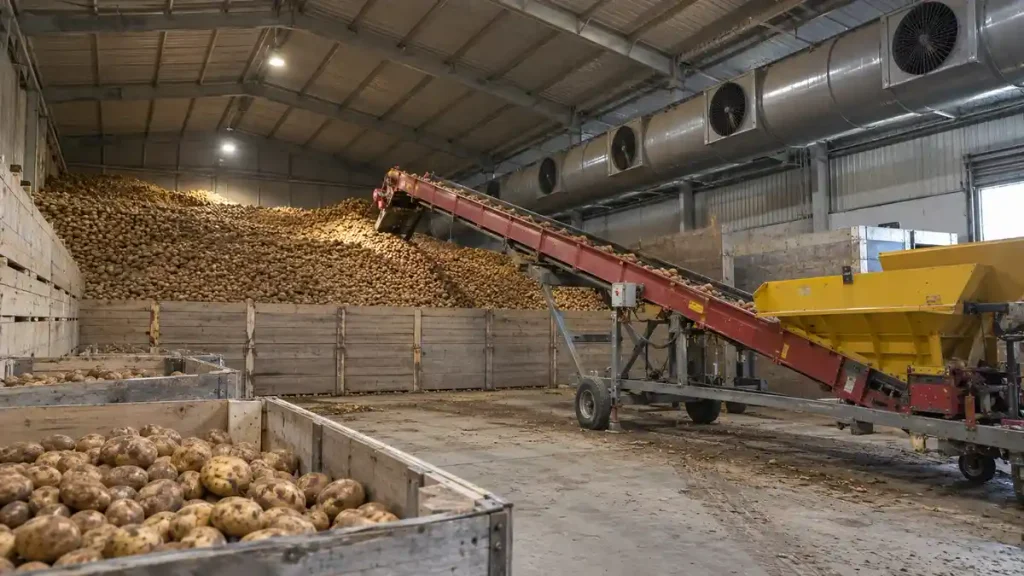
Storage losses include weight reduction, rotting, sprouting, bruising and changes in processing quality. These losses reduce the quantity or value of the crop that can be sold.
A USDA research project hosted by the National Agricultural Library reports that storage losses in Idaho are approximately 6% to 7% in most years, with higher losses possible when frost damage or wet rot affects the crop. This is a regional reference, not a national average for all potato storage facilities.
A separate 2024 study published in Biosystems Engineering examined four russet potato varieties over nine months. It found that water loss was the main contributor to weight loss, with results varying by variety and storage conditions.
The main causes of storage losses include:
- Moisture loss: Potatoes lose water through their skin, reducing saleable weight.
- Disease and rot: Infected or damaged tubers can deteriorate during storage.
- Sprouting: Sprouts reduce market quality and may affect processing performance.
- Physical damage: Cuts, bruises and skin damage increase the risk of deterioration.
- Processing-quality changes: Stored potatoes may no longer meet a processor’s requirements.
Good storage management starts before potatoes enter the building. Careful harvesting, suitable loading conditions, airflow management and regular inspection can help limit losses.
Also read: Potato Consumption Per Capita by Country
How to Calculate the Cost of Storage Per Ton
The cost per unit of stored potatoes helps growers compare facilities, storage periods and investment options.
Calculate the storage cost per ton by dividing total storage expenses by the quantity of potatoes stored.
Storage cost per ton = Total storage expenses ÷ Quantity stored
Include electricity, labor, maintenance, treatments, insurance, financing and the annual share of building and equipment costs. First calculate operating expenses separately from crop losses, then include the value of lost potatoes to understand the full economic cost.
Illustrative example
Suppose a US grower stores 1,000 US short tons of potatoes. Annual operating expenses are $30,000 and the estimated marketable loss is 6%.
| Item | Illustrative result |
|---|---|
| Quantity initially stored | 1,000 US short tons |
| Operating expenses | $30,000 |
| Operating cost per initial short ton | $30 |
| Marketable quantity after 6% loss | 940 US short tons |
| Operating cost per remaining short ton | $31.91 |
This example excludes construction depreciation, financing and the sales value of lost potatoes. The 6% loss is an assumption for calculation, not a prediction for a particular facility.
The example shows why calculating costs only against the quantity initially stored can understate the expense associated with each saleable unit.
Is Building a Potato Storage Facility Worth the Investment?
Building a storage facility can make financial sense when the expected value of holding potatoes exceeds the cost of construction, financing, operation and losses. The answer depends on the grower’s market access, crop volume, quality requirements and ability to sell at a better time.
Before investing, compare three options.
- Build a new facility: Consider this when long-term storage needs justify the capital investment and expected utilization.
- Upgrade existing storage: Consider insulation, airflow, controls or refrigeration improvements when the current building is suitable.
- Use third-party storage: Compare the storage fee, handling charges, transport costs, crop access and loss terms against owning a facility.
The right comparison includes the total cost of delivering marketable potatoes to the buyer, not just the warehouse operating bill.
Also read: Top 10 Potato Producing Countries in the World
Conclusion
Commercial potato storage economics depend on the relationship between investment, energy consumption and marketable crop losses. Growers should measure electricity use, calculate storage cost per saleable unit and track losses by variety and storage period.
Before building or upgrading a facility, obtain local construction and equipment quotes, review actual electricity tariffs and prepare a financial model using realistic crop values and storage performance. These figures provide a stronger basis for deciding whether ownership, upgrades or rented storage offer the best return.
FAQs
-
How much does it cost to build a commercial potato storage facility in the USA?
There is no verified single national construction price. Obtain quotes based on capacity, location, insulation, ventilation, refrigeration, site work and installation.
-
What is the biggest energy expense in potato storage?
Refrigeration can be a major electricity user. Its share depends on the system, climate and operating conditions.
-
What percentage of potatoes are lost during storage?
Losses vary by crop condition, variety and storage management. A USDA-hosted research project reports approximately 6% to 7% storage losses in Idaho in most years.
-
How can growers reduce potato storage costs?
Improve insulation, maintain fans and refrigeration equipment, monitor crop conditions and reduce damage during harvesting and handling.
-
Is it cheaper to rent storage or build a facility?
Renting may reduce upfront capital requirements, while owning may make sense for growers with enough consistent volume. Compare full annual costs, crop losses and access to stored potatoes before deciding.
Image (AI generated) credit: Potato Insights
Sources & references:
- Cold Storage Construction Cost Per Square Foot (2026), US Cold Storage Builders
- Investigating Disease Control Options for Potatoes in Storage, National Agricultural Library, USDA
- Relative contributions of respiration and transpiration to the weight loss of russet-type potatoes, USDA Agricultural Research Service
- Potato Stocks, National Agricultural Statistics Service, USDA
- Methodology for energy demand reduction of potato cold storage process, Journal of Food Process Engineering
- Nutrient-Packed and Pest-Resistant Potatoes From ARS Research, USDA Agricultural Research Service
Recent Articles


"Get the latest potato industry updates in Google Search. Add Potato Insights as a preferred source for potato markets, processing, trade and industry news."