
U.S. Potato Acreage Falls 3% in 2026: What It Means
U.S. potato acreage falls 3% in 2026 to 873,000 acres. See what lower supply means for growers, processors, prices and the potato market.
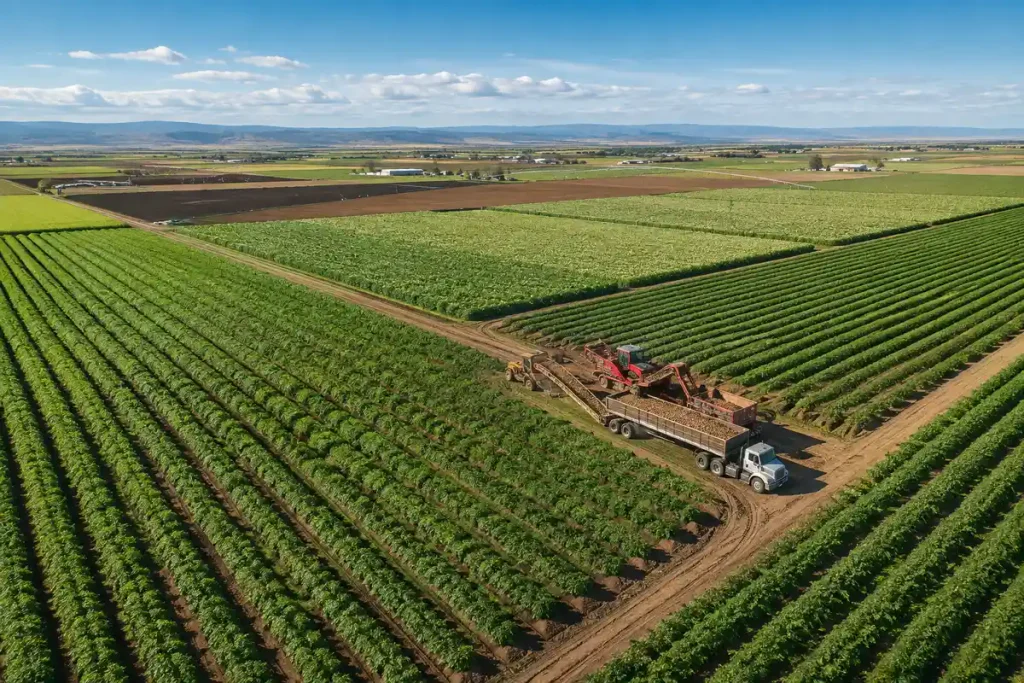
U.S. growers planted 873,000 acres of potatoes in 2026, down 29,000 acres or about 3%, from 2025. It is the smallest planted area across the 13 USDA potato-reporting states since 1952.
The reduction comes after several years of softer potato prices and weaker returns in some market segments. Idaho accounts for about half of the national acreage decline, with planted area falling by 15,000 acres to 300,000 acres.
For growers, processors, packers and buyers, the smaller crop could change supply conditions during the 2026/27 marketing year. But the effect will depend on yields, demand, contracts, storage and how quickly the market absorbs the lower production.
What happened to U.S. potato acreage in 2026?
USDA data show that potato acreage fell across eight of the 13 states included in the annual survey. No state reported an increase.
| State | 2026 Acreage Change |
|---|---|
| Idaho | -15,000 acres |
| North Dakota | -3,000 acres |
| Colorado | -2,000 acres |
| Michigan | -2,000 acres |
| Minnesota | -2,000 acres |
| Nebraska | -2,000 acres |
| Wisconsin | -2,000 acres |
| California | -1,000 acres |
| Florida | Unchanged |
| Maine | Unchanged |
| Oregon | Unchanged |
| Texas | Unchanged |
| Washington | Unchanged |
The 873,000-acre total is 29,000 acres below 2025 and 59,400 acres below the five-year average for the same reporting states.
That makes the decline more than a one-year adjustment. USDA’s Economic Research Service describes 2026 as the third consecutive year of lower potato plantings.
Also read: Fresh vs Processed Potatoes: Which Is More Profitable?
Why are growers planting fewer potatoes?
Lower prices are a major part of the story.
USDA ERS reported a preliminary 2025/26 season-average potato grower price of $11.20 per cwt. The figure was 13% below the nominal record of $12.90 per cwt recorded in 2022/23. Softer fresh-market prices and modest declines in processing contract prices put pressure on grower returns.
The market structure also matters. Over recent seasons, processing potatoes accounted for about 70% of U.S. potato sales volume, while fresh table potatoes represented about 25%, seed about 5% and livestock feed about 0.3%.
You might also like
-
 The Journey of McDonald’s French Fries From Farm to Fryer
 -
 Best High-Yield Potato Varieties in India
 -
 Smart Packaging Trends Changing the Potato Chips and Snacks Market
 -
 India Potato Exports to Indonesia in 2025 – Market Trends & Price Outlook
 -
 The Truth About Potato Peel Waste Around the World
 -
 Top Potato Exporting Countries Ranked by Value
For growers, that means acreage decisions are closely linked to processor contracts as well as fresh-market conditions.
USDA’s April outlook had already pointed to lower fresh grower prices and stagnant demand for contracted processing acreage as reasons for expecting a reduction in 2026 plantings. The final acreage estimate came in even lower than that earlier expectation.
What does the acreage decline mean for potato supply?
Fewer planted acres do not automatically mean a matching fall in production.
Yield is the other major variable. USDA-related estimates indicate that 867,600 of the 873,000 planted acres are expected to be harvested. Using trendline yields and average abandonment, the 2026 U.S. crop would be about 403.4 million cwt. That would be around 9.5 million cwt below production in the reporting states in 2025, a decline of about 2.3%.
So the expected production decline is smaller than the acreage decline.
That matters because continued improvements in varieties, yields and storage can allow the industry to meet demand with fewer acres than in the past. This can reduce the immediate supply impact of acreage cuts.
Still, a smaller crop leaves less room for unexpected losses from weather, disease, quality problems or storage issues.
What does this mean for potato growers?
For growers, the acreage decline could eventually provide some support to prices if demand remains steady and production falls as expected.
But acreage cuts alone do not guarantee better margins.
The 2026 season began after a period of weak table potato prices and some growers reduced production because returns were under pressure. If demand does not improve, lower acreage may only partly correct the market imbalance.
Also read: Best Potatoes for French Fries in the USA: A Complete Guide
Growers will need to watch several indicators closely.
- Fresh potato grower prices
- Processor contract volumes and prices
- Yield per acre
- Storage stocks
- Open-market movement
- Demand for processing potatoes
- Input and freight costs
There is already one sign worth watching. USDA reported that fresh potato grower prices increased 20% from April to May 2026. That does not establish a lasting price recovery, but it shows how quickly conditions can change when supply tightens.
What does this mean for potato processors?
Processors may see a different effect from fresh-market buyers.
Processing accounts for the largest share of U.S. potato sales, so changes in contracted acreage can directly affect raw potato availability. The 2026 acreage reduction was partly linked to reduced demand for some processing uses, including dehydrated potatoes.
For processors, the key issue is not simply whether 29,000 acres disappeared. It is whether the remaining crop provides enough potatoes with the right variety, quality, size, solids and delivery timing.
A smaller crop can make procurement more sensitive to yield problems. Processors may also have less flexibility to source additional potatoes on the open market if contract supplies fall short.
At the same time, higher yields and better storage can reduce the pressure created by lower acreage.
Could potato prices rise in 2026/27?
There is a reasonable case for upward price pressure, but it is too early to assume a large price increase.
The expected 2.3% production decline is modest compared with the 3% acreage reduction. Demand will also determine how much of the lower supply reaches the market.
Fresh potatoes may respond more quickly because fresh-market prices are more sensitive to changes in production than processing prices, which are often supported by pre-season contracts.
Processors could see less immediate price movement where contracts already determine much of the raw potato supply.
The bigger question is whether lower acreage is enough to bring supply and demand into better balance after several years of weak pricing.
Also read: Best Frozen French Fries Manufacturers in the USA
Key 2026 U.S. potato market numbers
| Indicator | 2026 Figure |
| Planted potato acreage | 873,000 acres |
| Change from 2025 | -29,000 acres |
| Year-over-year change | About -3% |
| Expected harvested area | 867,600 acres |
| Estimated crop using trendline yield | 403.4 million cwt |
| Expected production change | About -2.3% |
| Idaho planted acreage | 300,000 acres |
| Idaho acreage change | -15,000 acres |
| Preliminary 2025/26 grower price | $11.20 per cwt |
Sources for the data include USDA NASS, USDA ERS and the Michigan Potato Industry Commission’s market reporting based on North American Potato Market News.
What should growers and processors watch next?
The acreage report gives the market an important starting point, but the next signals will come from actual yields, harvest progress, storage conditions, shipments, prices and demand.
For growers, the main opportunity is that tighter supply could improve pricing if demand holds. For processors, the focus will be on securing enough suitable raw potatoes without overpaying for supply that the market does not need.
The 2026 acreage decline is therefore best viewed as a market adjustment rather than a guaranteed price recovery. If production falls while demand stays firm, growers could gain pricing power. If demand remains weak, the smaller acreage base may not be enough to restore margins.
Also read: Potato Consumption Per Capita by Country
FAQs
-
How much did U.S. potato acreage fall in 2026?
U.S. growers planted 873,000 acres, down 29,000 acres or about 3%, from 2025. It is the lowest planted area since 1952 across the 13 reporting states.
-
Which state had the largest potato acreage decline?
Idaho had the largest reduction, with planted acreage falling by 15,000 acres to 300,000 acres, a 5% decline from 2025.
-
Will lower potato acreage increase prices?
Lower acreage can support prices if production falls and demand remains steady, but acreage alone does not determine prices. Yield, stocks, demand and processing contracts also matter.
-
How much of the U.S. potato crop goes to processing?
Processing has accounted for about 70% of U.S. potato sales volume over recent seasons, compared with about 25% for fresh table potatoes.
-
What should potato processors watch in 2026?
Processors should watch harvested acreage, yields, contract volumes, raw potato quality, storage stocks, open-market prices and demand for processed potato products.
Image credit: Potato Insights
Sources:
- Vegetables and Pulses Outlook: July 2026 — USDA Economic Research Service
- Vegetables and Pulses – Market Outlook — USDA Economic Research Service
- Vegetables and Pulses Outlook: April 2026 — USDA Economic Research Service
- Market Report July 1, 2026 — Michigan Potato Industry Commission
- Idaho Potato Acres Drop by 5% — Idaho Farm Bureau Federation
- Market Report July 29, 2026 — Michigan Potato Industry Commission
Recent Articles


"Get the latest potato industry updates in Google Search. Add Potato Insights as a preferred source for potato markets, processing, trade and industry news."