How Are Crinkle Cut French Fries Made? Factory Process Explained
Learn how crinkle cut French fries are made, from potato selection and corrugated cutting to blanching, par-frying, freezing and final cooking.
Crinkle cut French fries are made by cutting potatoes with corrugated blades that create the familiar ridged surface, then blanching, drying, partially frying, freezing and finally cooking them.
The basic process is similar to other frozen French fries, but the cutting stage gives crinkle fries their distinctive shape. The process is highly controlled because potato variety, cutting size, moisture, frying conditions and freezing all affect the final color and texture.
In the U.S., frozen French fries are widely used in foodservice, with most frozen fries moving through restaurants and other foodservice channels.
How Are Crinkle Cut French Fries Made?
Commercial crinkle cut fries generally go through these main steps.
- Potato selection
- Washing and sorting
- Peeling
- Crinkle cutting
- Blanching
- Drying
- Par-frying
- Freezing
- Packaging and storage
- Final cooking
Also read: USA vs Canada Frozen French Fry Industry
1. Potatoes are selected and inspected
The process starts with mature potatoes suitable for French fry production. Potatoes are inspected and sorted before processing. Damaged or unsuitable potatoes can be removed so the finished fries have a more consistent appearance and quality.
USDA describes frozen French fried potatoes as products made from mature, sound white or Irish potatoes that are washed, sorted and trimmed as needed.
2. Potatoes are washed and peeled
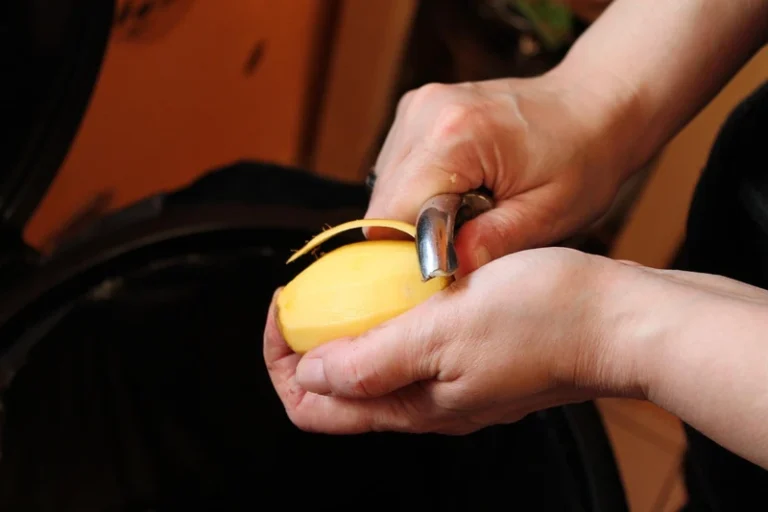
The potatoes are thoroughly washed to remove soil and other material from the surface. Depending on the product, the potatoes may then be peeled.
Commercial plants use mechanical or steam-based peeling systems to prepare large volumes of potatoes for cutting. Some specialty fries can retain the skin, but traditional crinkle cut fries are commonly sold without skin.
3. Potatoes are cut with corrugated blades
This is the step that makes crinkle cut fries different.
You might also like
-
 Study Shows Global Potato Processing Industry Faces Tech and Eco Test
 -
 Wisconsin Potato Industry: Production, Processing & Market Outlook
 -
 KFC Asks Fans to Decide Future of Potato Wedges
 -
 Innovation in Potato Processing: Turnkey Solutions from Fry and Bake
 -
 Fresh vs Processed Potatoes: Which Is More Profitable?
 -
 Top Potato Chips Manufacturers in the USA
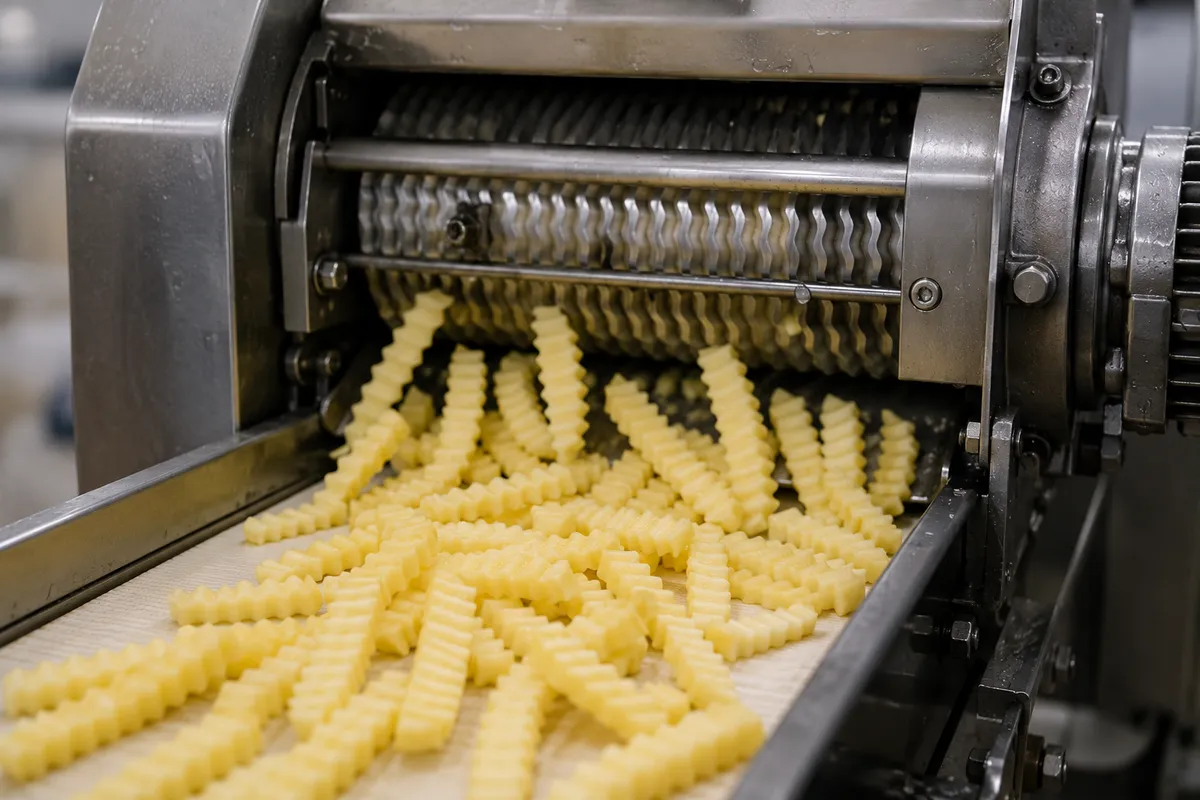
Instead of using a flat cutting blade, processing equipment uses corrugated or wavy-edged knives. The potato passes through the cutting system and is formed into long strips with ridges and grooves on their surfaces.
The cutting system can be adjusted for different fry sizes. Commercial products, for example, are available in sizes such as 5/16 inch and 3/8 inch.
Those ridges aren’t just for appearance. The corrugated surface creates more edges and changes the way the fry interacts with oil and sauces. This can contribute to a crisp texture and help sauces cling to the fry.
4. The potato strips are blanched
After cutting, the strips are usually blanched in hot water. Blanching partially cooks the potato and helps control enzymes that can cause quality and color problems.
USDA processing guidance describes blanching as a hot-water treatment that partially cooks the sliced potatoes before further processing.
Blanching is also useful for frozen food processing because partial cooking helps control enzyme activity before freezing.
Also read: Top Potato Chips Manufacturers in the USA
5. Excess moisture is removed
The blanched fries need to be dried before frying. Forced air or other drying systems can remove surface moisture.
This matters because the amount of moisture entering the fryer affects how the potato cooks and how its exterior develops during frying. USDA inspection guidance notes that blanched potatoes may pass through heating units and forced air before entering the fryer.
6. The fries are par-fried
The strips are then partially fried in hot oil. This is often called par-frying.
Commercial frozen French fries are commonly partially fried before freezing so that restaurants and other foodservice operators can finish cooking them later. USDA describes commercial frozen French fry processing as including frying or blanching, followed by freezing.
Some processing systems use more than one frying stage. USDA’s inspection guidance describes continuous frying systems and notes that some manufacturers use a double-fry process.
7. The fries are frozen
After par-frying, the fries are cooled and frozen for distribution. Frozen processing allows the product to be stored and transported before it reaches restaurants, cafeterias, supermarkets or other customers.
Rapid freezing is useful for frozen food quality because slower freezing can create larger ice crystals that can damage food structure.
8. The frozen fries are packaged and shipped
The frozen crinkle cut fries are packed and stored under controlled frozen conditions. The finished product can then be shipped to foodservice operators or retail customers.
USDA standards classify frozen French fries into retail and institutional types based on intended use.
Why Do Crinkle Cut Fries Have Ridges?
The ridges come directly from the corrugated cutting blades used during processing. The wavy surface gives crinkle fries a different texture from straight-cut fries.
The grooves also increase the amount of surface geometry available for contact with oil and sauces. This is one reason the shape can produce a different eating experience from a smooth-sided fry.
Also read: Fresh vs Processed Potatoes: Which Is More Profitable?
Are Frozen Crinkle Cut Fries Already Fried?
Usually, commercially produced frozen French fries are at least partially fried before freezing. The final cooking step happens later, often in a restaurant fryer or another cooking system.
The exact process depends on the product. Some frozen products are designed for deep frying, while others are prepared for ovens or other cooking methods.
Crinkle Cut vs. Straight Cut Fries
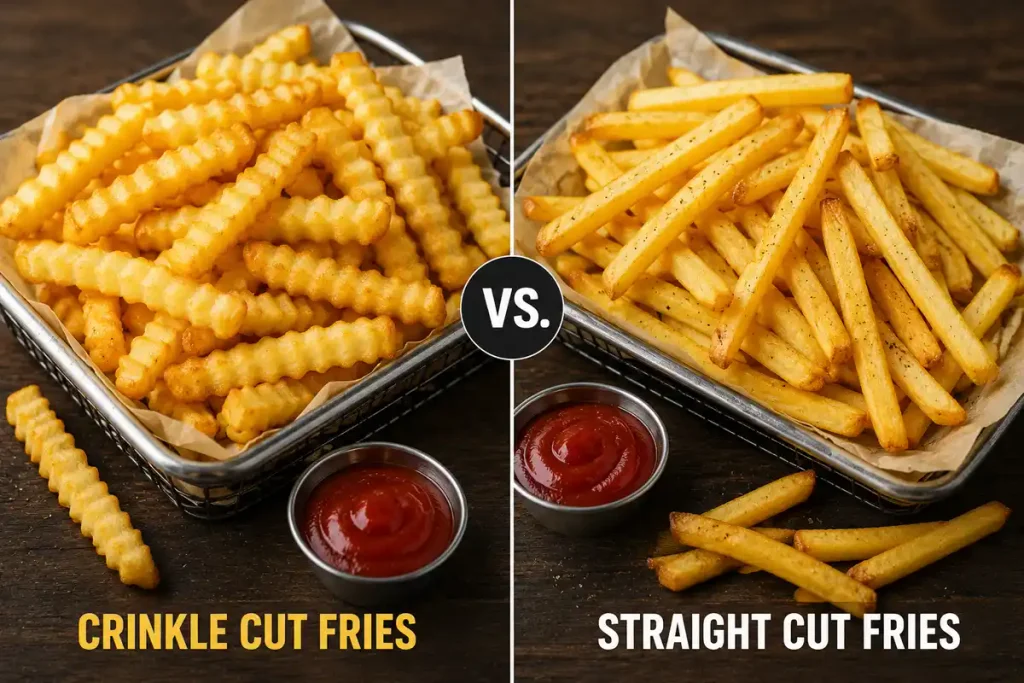
The biggest difference is the cutting method.
| Feature | Crinkle Cut Fries | Straight Cut Fries |
|---|---|---|
| Surface | Wavy and ridged | Smooth |
| Cutting blade | Corrugated | Straight |
| Texture | More pronounced ridges and edges | More uniform surface |
| Sauce handling | Grooves can help hold sauces | Smoother surface |
| Processing | Wash, cut, blanch, dry, fry, freeze | Similar process |
The later processing stages are broadly similar. The main difference happens when the potato is cut.
What Makes Commercial Crinkle Fries Consistent?
Consistency depends on controlling several parts of the process, including potato quality, strip dimensions, blanching, moisture removal, frying and freezing.
USDA quality standards for frozen French fries consider factors such as color, size and symmetry, defects, flavor and texture.
For manufacturers, that means producing a crinkle shape is only one part of the job. The strips also need to survive blanching, frying, freezing, transport and final cooking while maintaining the desired appearance and texture.
Final Takeaway
Crinkle cut French fries start as whole potatoes and become the familiar ridged fries through a controlled processing sequence. The defining step is the use of corrugated cutting blades, followed by blanching, drying, par-frying, freezing and final cooking.
For consumers, the ridges are mostly part of the texture and eating experience. For potato processors, they are the result of precise cutting and careful control throughout the rest of the production process.
Also read: Potato Consumption Per Capita by Country
FAQs
-
How are crinkle cut fries cut?
They are cut using corrugated blades that create ridges and grooves along the potato strips.
-
Are crinkle cut fries made from whole potatoes?
Commercial frozen crinkle cut fries generally begin with whole potatoes that are washed, sorted, prepared and cut into strips.
-
Why are crinkle cut fries crispy?
Their ridged shape creates additional edges and surface area, which can contribute to a crisp texture during frying.
-
Are frozen crinkle cut fries already cooked?
Most commercial frozen French fries are partially cooked through blanching and/or frying before they are frozen. They normally require final cooking before serving.
-
What happens to crinkle cut fries after par-frying?
They are typically cooled, frozen, packaged, stored and shipped. The final cooking takes place later, depending on the product and its intended use.
Image credit: Potato Insights
Sources:
- Frozen French Fried Potatoes Grades and Standards — USDA Agricultural Marketing Service
- Frozen French Fried Potatoes Standard — USDA Agricultural Marketing Service
- Frozen French Fried Potatoes Inspection Instructions — USDA Agricultural Marketing Service
- Fries on the Rise: Nearly Half of Potatoes Now Go Into Frozen Products — USDA Economic Research Service
- Crinkle Cut Fries — Simplot Food
- When Frozen Is Better Than Fresh: The Lesson of Shake Shack’s Crinkle-Cut Fries — Food Republic
Recent Articles



"Get the latest potato industry updates in Google Search. Add Potato Insights as a preferred source for potato markets, processing, trade and industry news."