North Dakota Potato Industry 2026: Production, Processing and Markets
North Dakota's potato acreage is changing, but processing investment is growing. Here is a look at 2026 production, varieties, storage and the new processing capacity shaping the state's potato industry.
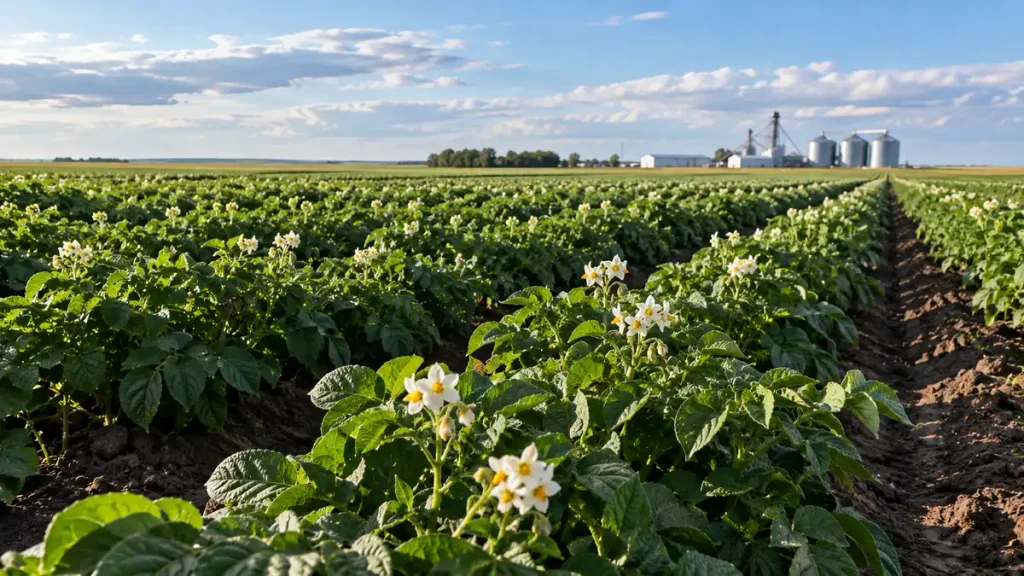
North Dakota remains an important U.S. potato-producing state, with 70,000 acres planted and 69,000 acres harvested in 2025. The crop produced 24.84 million cwt, with an average yield of 360 cwt per acre and a reported production value of about $315.5 million.
The 2026 season is taking place as the state’s potato industry prepares for major changes in processing capacity. A new Agristo processing facility is under construction in Grand Forks, while existing processors such as Cavendish Farms continue to support demand for processing potatoes.
For growers, processors, seed suppliers, equipment companies and other potato businesses, the key areas to watch are production, varieties, storage, processing demand and the expansion of the value-added potato sector.
North Dakota potato production in 2026
The latest complete USDA production data is for the 2025 crop. North Dakota planted 70,000 acres and harvested 69,000 acres, producing 24.84 million cwt at an average yield of 360 cwt per acre. The USDA reported a marketing-year average price of $12.70 per cwt and a production value of $315.5 million.
For comparison, the 2024 crop produced 24.288 million cwt from 72,500 harvested acres, with an average yield of 335 cwt per acre.
The USDA’s 2026 North Dakota agriculture overview currently lists 67,000 planted acres and 66,000 harvested acres for potatoes. Production and yield are not yet reported in that overview, so a final 2026 production figure should not be assumed from acreage alone.
| North Dakota potato data | 2024 | 2025 | 2026 |
|---|---|---|---|
| Planted acres | 73,000 | 70,000 | 67,000 |
| Harvested acres | 72,500 | 69,000 | 66,000 |
| Yield | 335 cwt/acre | 360 cwt/acre | Not yet reported |
| Production | 24.288 million cwt | 24.840 million cwt | Not yet reported |
The 2025 figures show why acreage alone does not tell the full story. Harvested area declined from 2024, while average yield increased enough to keep total production slightly higher.
Where North Dakota potatoes are grown
The Red River Valley is one of the main areas connected with North Dakota’s potato industry. Its agricultural base supports fresh, processing, chipping and seed potato production.
Grand Forks is becoming especially important because of new processing investment. Agristo selected the area for its first U.S. production facility after working with growers on trials of European potato varieties.
The state’s potato supply chain also extends beyond farms. It includes certified seed producers, storage operators, packers, processors, transportation companies and food manufacturers.
You might also like
-
 National Potato Fair 2026 Held in Modipuram
 -
 Dhanuka Agritech Warns Potato Farmers About Early and Late Blight
 -
 Bangladesh Potato Farmers Face Heavy Losses as Prices Drop
 -
 Bangladesh’s Potato Problem Is About Policy, Not Farming
 -
 Aeroponics Changes How Potatoes are Grown in Haryana, India
 -
 Ben Sklarczyk Elected 2026 National Potato Council President
Potato varieties grown in North Dakota
North Dakota has a broad range of potato genetics because growers serve several markets. The North Dakota State Seed Department maintains a collection containing 67 varieties and 80 selections, including Russet Burbank, Russet Norkotah, Ranger Russet, Umatilla Russet, Dakota Russet, Dakota Trailblazer, Yukon Gold and many red and yellow varieties.
Russet varieties are particularly important for processing. Cavendish Farms states that Russet Burbank is the predominant variety in its Jamestown growing region and is used for French fry production.
The seed sector is also seeing greater interest in yellow varieties. North Dakota State Seed Department data shows certified yellow seed potato acreage increased from 390.94 acres in 2024 to 717.23 acres in 2025. Fontane was a major part of this increase, with acreage rising from 29.7 acres to 191.9 acres.
Fontane is a long-processing variety of Dutch origin. The North Dakota State Seed Department describes it as an early-maturing variety with high yield potential and suitability for dryland production. Its increasing acreage is closely linked to planned processing demand from Agristo.
Also read: Oregon Potato Industry: Production, Processing, Varieties and Market
Potato processing is changing the market
Processing is one of the biggest developments in North Dakota’s potato industry.
Cavendish Farms operates a potato processing facility in Jamestown. The company says the location processes Russet Burbank potatoes into French fries supplied to restaurants in North America and other markets.
Agristo is adding another major processing operation in Grand Forks. Construction began with site preparation in 2025, followed by the official groundbreaking in July 2026. The facility is expected to become operational in 2029.
At full capacity, the Grand Forks facility is planned to process about 1.1 billion pounds of potatoes annually and produce about 550 million pounds of finished products. The project is also expected to work with more than 50 contracted growers across roughly 20,000 acres.
The plant is planned for frozen potato products, including French fries, hash browns and other specialties. This gives growers another large processing outlet while increasing the need for suitable varieties, storage and farm-level production planning.
What the processing expansion means for growers
A larger processing base can change the type of potatoes growers plant and the way they manage contracts, storage and quality.
Processors need potatoes that meet specific requirements for size, solids, fry color, sugar levels, defects and storage performance. Variety selection therefore becomes a business decision as well as an agronomic decision.
North Dakota’s seed certification system supports this supply chain. The State Seed Department handles field inspections, post-harvest testing, shipping-point inspections and other services connected with certified seed potatoes.
For processing potatoes, inspections can also be used to help determine payment to producers.
Also read: Wisconsin Potato Industry: Production, Processing & Market Outlook
Storage and supply planning
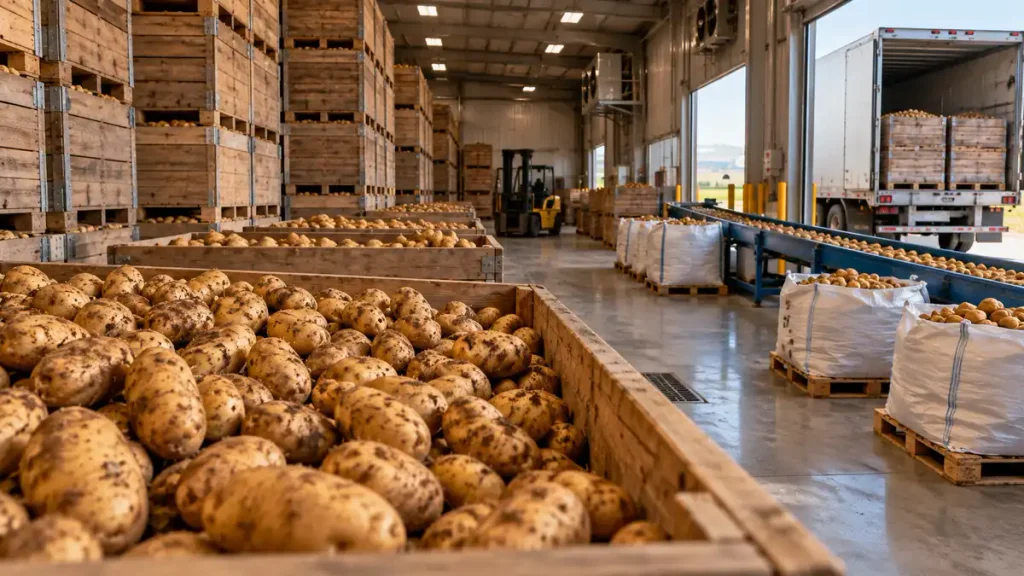
Storage is becoming increasingly relevant as North Dakota prepares for additional processing demand.
USDA reported that North Dakota had 3.2 million cwt of 2025 potatoes in storage on June 1, 2026, equal to 13% of the state’s 2025 production.
For growers supplying processors, storage can help extend the marketing window and support more consistent raw material supply. The Agristo project has already encouraged some regional producers to consider additional storage capacity ahead of the plant’s expected increase in potato demand.
North Dakota potato industry outlook for 2026
North Dakota enters 2026 with a smaller potato acreage base than in 2024 and 2025, but with major investment taking place on the processing side.
The most significant development is the Agristo facility in Grand Forks. Its planned capacity will create additional demand for processing potatoes and could affect acreage, variety selection, seed production, storage and transportation across the Red River Valley.
At the same time, the state’s existing mix of fresh-market, chip, processing and seed potatoes gives growers several market channels. The exact effect of new processing capacity will depend on plant construction, grower contracts, variety requirements, production costs and future potato demand.
For businesses watching the U.S. potato market, North Dakota is therefore a state to follow closely through the rest of the decade.
Conclusion
North Dakota’s potato industry in 2026 is defined by two different trends. Current acreage is below the levels reported in 2024 and 2025, while processing investment is expanding.
The combination of established processors, certified seed production and the new Agristo facility is creating a changing market for growers and potato businesses. Production data for the 2026 crop is still developing, but variety selection, storage and processing demand will be important factors to watch as North Dakota’s potato supply chain prepares for the next stage of growth.
Also read: Idaho Potato Industry: Production, Varieties & Market Outlook
FAQs:
-
How many potatoes does North Dakota produce?
North Dakota produced 24.84 million cwt of potatoes in 2025, according to USDA data.
-
How many acres of potatoes are planted in North Dakota in 2026?
The USDA’s current 2026 overview lists 67,000 planted acres and 66,000 harvested acres.
-
What potato varieties are grown in North Dakota?
North Dakota grows many varieties, including Russet Burbank, Russet Norkotah, Ranger Russet, Umatilla Russet, Dakota Russet, Yukon Gold and Fontane.
-
What is the Agristo potato plant in North Dakota?
Agristo is building a large frozen potato processing facility in Grand Forks, with full operation targeted for 2029.
-
Why is Fontane becoming important in North Dakota?
Fontane acreage increased sharply in 2025 as the variety is being developed for processing demand associated with the Agristo project.
Image credit: Potato Insights
Sources and References:
- 2026 State Agriculture Overview: North Dakota — USDA National Agricultural Statistics Service
- 2025 State Agriculture Overview: North Dakota — USDA National Agricultural Statistics Service
- Annual Statistical Bulletin 2025, Potatoes — USDA/NASS
- Crop Production, November 2025 — USDA/NASS
- Potato Stocks, June 18, 2026 — USDA/NASS
- Potato Seed Stocks & Tissue Culture — North Dakota State Seed Department
- Potato Program — North Dakota State Seed Department
- The North Dakota Seed Journal, October 2025 — North Dakota State Seed Department
- Agristo Grand Forks Potato Processing Facility — Grand Forks Region Economic Development Corporation
- Where We Grow — Cavendish Farms
Recent Articles
Follow us to receive updates🔔